SPECIFY THE PART, NOT ONLY THE GAUGE
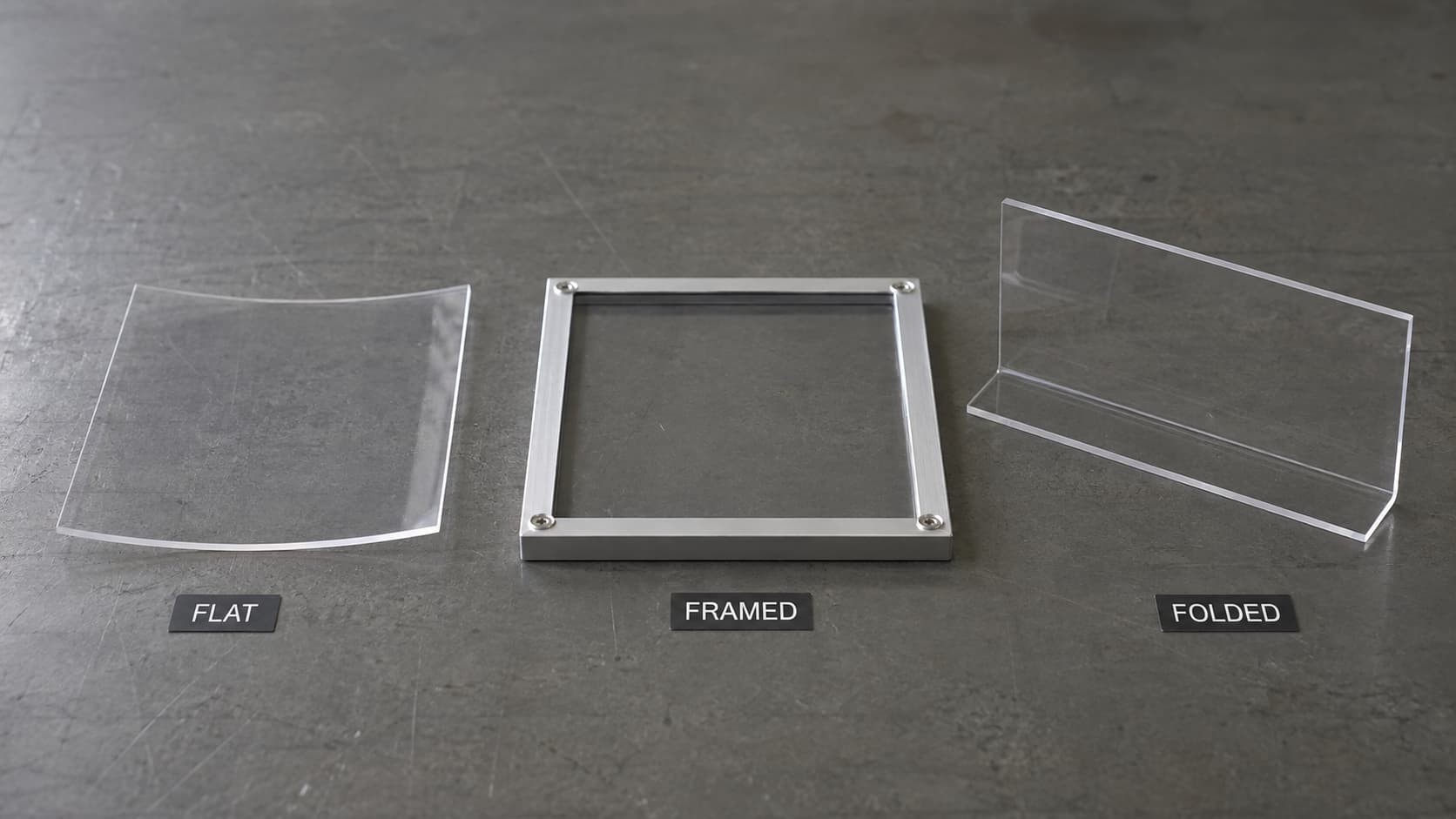
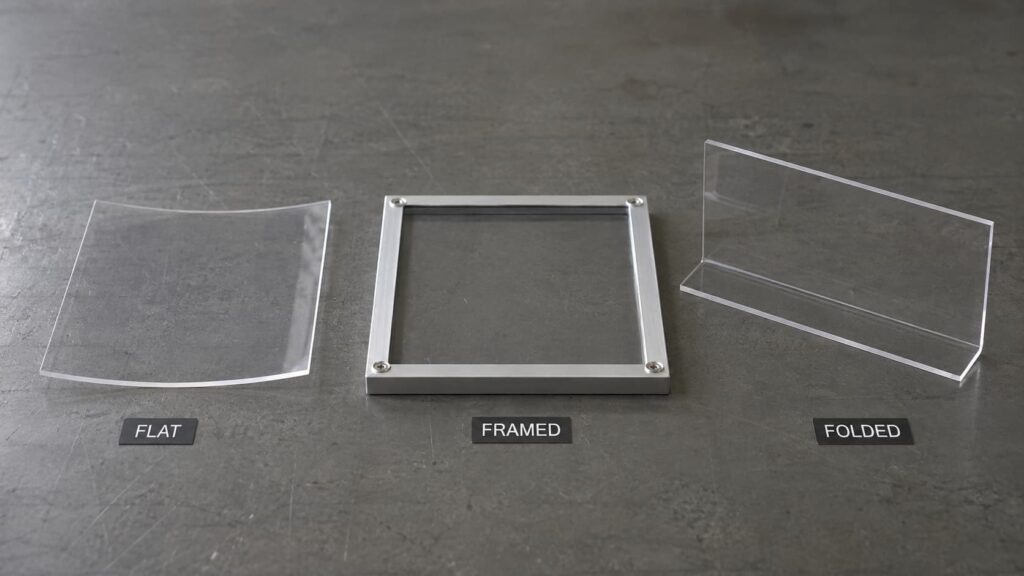
Same gauge.
Three different structures.
A flat panel asks the sheet to carry its own shape. A frame shares that job. A fold creates stiffness through geometry. Thin acrylic succeeds or fails inside the finished design—not on a thickness label.
Thin acrylic works when the design supplies the stiffness the sheet does not.
“2 mm acrylic” is a material callout—not a finished-part specification.
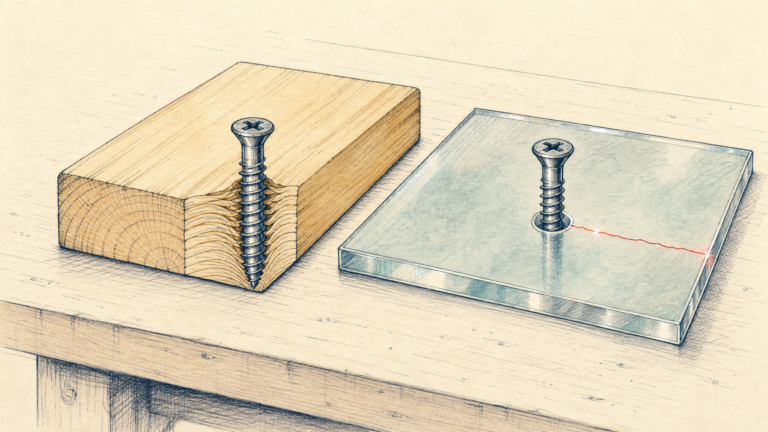
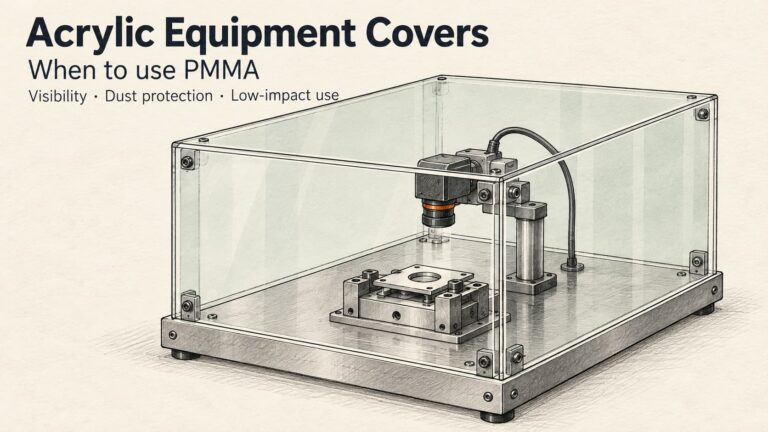
Two parts can both be specified as 2 mm acrylic and behave nothing alike. A framed insert gains support from its edges. A folded brochure pocket gains stiffness from its bends. An unsupported equipment cover made from the same nominal thickness may flex or bow during handling.
Finished size, unsupported span, support points, geometry, holes, bends, assembly, appearance, and packaging all affect whether a thin sheet becomes a reliable component. The millimeter number does not know how wide the panel is—or what happens after cutting.
QUICK ANSWER
Thin acrylic is a design category before it is a catalog category.
- For this guide, thin acrylic means conventional PMMA sheet in an approximate 1–3 mm working range. This is an editorial range, not a universal industry definition or a statement of available stock.
- Thin sheet works best as a supported layer, insert, lens, formed pocket, printed panel, or lightweight enclosure component.
- It is a poor choice when a broad panel must remain rigid without support, carry load, resist repeated impact, or hold tightly installed hardware by itself.
- The full part and manufacturing route must be reviewed together.
When Is a Thin Acrylic Sheet the Right Choice?
Use the finished design—not a material swatch—to make the first decision. This matrix is a feasibility screen, not a structural calculation.
| Design Condition | Evaluate Thin Sheet | Reconsider Gauge or Design |
|---|---|---|
| Support | SUPPORTED Framed, backed, laminated, or continuously supported | FREE SPAN Broad unsupported area or long distance between supports |
| Geometry | FORMED Folded, curved, flanged, ribbed, or assembled into a stiff form | FLAT Large flat geometry expected to stay rigid by itself |
| Load and Handling | CONTROLLED Lightweight visual layer with limited handling | DEMANDING Shelf, guard, load-bearing part, or frequently impacted panel |
| Mounting | DISTRIBUTED Captured edges, distributed clips, or low-stress attachment | CONCENTRATED Tight fasteners, point loads, or holes close to edges |
| Fit and Appearance | VALIDATED Representative part can be checked in its final assembly | ASSUMED Strict flatness or tight slot fit approved from nominal gauge alone |
If the part is framed, folded, curved, laminated, or continuously supported, evaluate a thin sheet. If it must span, carry, fasten tightly, or stay flat by itself, thicken it or redesign the support.
Protective guards, safety glazing, load-bearing panels, and other risk-sensitive parts require application-specific engineering.Five Conditions Set the Real Limit
The thickness label starts the discussion. These five project conditions finish it.
-
01MAP THE FREE SPAN
Finished Size and Unsupported Span
A small panel and a large panel of the same gauge do not have the same rigidity. The free distance between frames, rails, fasteners, or bonded areas is often more useful than overall size.
-
02SHOW SUPPORT POINTS
Support and Mounting
Full backing or a perimeter frame distributes support. Isolated fasteners allow more flex and create local stress.
-
03SEND FULL GEOMETRY
Part Geometry
Bends, returns, curves, and assembled corners add stiffness. Wide flat areas, long narrow strips, and cutouts can remove it.
-
04DEFINE VISIBLE FACES
Handling and Appearance
Movement acceptable in a replaceable insert may look poor in a glossy customer-facing cover. Masking, stacking, and full-face packing also matter.
-
05REVIEW THE ROUTE
Downstream Processing
Cutting, drilling, forming, printing, bonding, and assembly introduce heat, clamping forces, stress, and fit requirements. The practical limit is the finished process window.
Where Thin Acrylic Works in Real Products
Thin acrylic is most useful where low weight, visual quality, and efficient conversion matter more than self-supporting rigidity. These are production roles—not universal thickness recommendations.
Graphic overlays, header cards, branded inserts, printed decorative panels
Backing, frame, or replaceable installationMenu holders, brochure pockets, sign holders, small display parts
Bends, returns, and short unsupported areasFramed sign faces, lightbox layers, diffuser or protective lenses
Correct grade, installed LED review, and frame supportSmall dust covers, housings, and enclosure skins
Captured edges, folds, curves, or assembled cornersCut, printed, bent, bonded, or assembled custom components
Full drawing and representative processed sampleLighting projects must evaluate optical grade and the installed LED condition as well as gauge. Continue with the guide to light-diffusing acrylic sheets when diffusion is part of the buyer task.
Fabrication Limits by Process
Thin acrylic is not inherently difficult to fabricate. It is less forgiving when support, heat, feature design, or the approval sample is ignored.
| Process | What Changes with Thin Sheet | Confirm Before Production |
|---|---|---|
| Laser Cutting | The sheet and narrow features can lift or distort if support, heat input, or cut sequence is unsuitable. | Layout, narrow features, masking, edge requirement, and a representative cut sample |
| CNC and Drilling | Poor hold-down allows vibration or movement; holes and slots concentrate stress. | Backing, fixturing, toolpath, hole position, fastener clearance, and edge quality |
| Bending and Forming | Thin material heats and cools quickly, so uneven heating or weak fixturing shows up fast. | Grade, geometry, heating zone, tooling, cooling, and final shape |
| Printing | Flatness, surface protection, ink system, and curing affect registration and appearance. | Print side, color target, masking removal, cure process, and full-size sample |
| Bonding and Assembly | Flexing transfers movement to joints; tight hardware adds stress around holes. | Joint design, adhesive process, assembly clearance, fastener load, and visible seams |
Nominal Thickness Is Not Assembly Thickness
A nominal 3 mm callout does not tell a fabricator how a tab should fit into a slot. Actual sheet thickness varies within the selected product’s specification. Cutting adds process variation, and the assembly needs intentional clearance.
ASTM D4802 provides a formal specification framework for PMMA acrylic plastic sheet.[1] Project drawings still need supplier- and grade-specific thickness data and part-level tolerances.
Common Thin-Sheet Failure Modes
Most thin-sheet failures are not mysterious material defects. They are unresolved interactions between span, processing, fit, handling, and packing.
- BOWBowing or CurlingCHECK SPAN + SUPPORT
The panel is too broad for its support, or processing and storage introduce uneven stress.
- FITPoor Slot or Tab FitCHECK TOLERANCE STACK
Nominal gauge was treated as the actual assembly dimension.
- HEATHeat Marks or Local DistortionCHECK PROCESSED SAMPLE
Cutting, forming, printing, or curing was not validated on the real geometry.
- HOLECracking Around HardwareCHECK FEATURE + LOAD
Edge distance, hole design, assembly clearance, or tightening stress is unsuitable.
- PACKSurface or Shipping DamageCHECK DELIVERY CONDITION
Thin parts lack suitable masking, interleaving, stacking, or full-face support.
Validate the Finished Part, Not Just the Raw Sheet
A flat coupon can confirm color and surface. It cannot prove that a long printed panel stays flat, a folded pocket holds its shape, or a slot fits the mating part.
PROOF LADDER
A raw sample proves the material. A fabricated sample proves the part.
- 01Material Sample
Confirm color, transparency, texture, surface, or optical appearance when critical.
PROVES MATERIAL - 02Representative Part
Use the intended size, cutting, holes, bends, print, joints, and support condition.
PROVES PROCESS - 03First Article
Inspect fit, flatness, visible edges, assembly, and handling against the drawing.
PROVES ASSEMBLY - 04Packing Review
Confirm masking, stacking, interleaving, full-face support, and outer packing.
PROVES DELIVERY
Choose the Supply Form—and Prepare the RFQ
The best delivery point depends on who controls the fabrication risk. As geometry and fit become more important, material approval and part approval become harder to separate.
Whole Sheets
Choose when your team controls cutting, fixtures, inspection, masking, and protective handling.
MATERIAL RELEASECut Blanks
Choose for simple profiles when downstream holes, forming, printing, or assembly remain in-house.
DIMENSIONAL RELEASEFinished Components
Choose when slots, holes, bends, print, bonding, or assembly must be validated together.
PART RELEASETHIN-SHEET REVIEW BRIEF
Send the conditions that the gauge cannot describe.
Leave the thickness open if you need a material and design review.
What the part does and its finished outside dimensions.
Support points, captured edges, fasteners, backing, or mating parts.
Requested material and nominal thickness, if already selected.
PDF, DXF, or CAD with cutouts, holes, slots, bends, and assemblies.
Surface, edge, print, optical, fit, or flatness expectations.
Sheet, blank, or finished component; packing priorities and destination.
Frequently Asked Questions
What thickness is considered a thin acrylic sheet?
There is no single universal boundary. This guide uses approximately 1–3 mm conventional PMMA sheet as a practical editorial range. Confirm available gauges, grade, dimensions, and tolerance with the supplier. Treat sub-millimeter precision sheet or film as a separate category.
Is 1 mm or 2 mm acrylic rigid enough for a panel?
Thickness alone cannot answer that. Finished size, unsupported span, frame design, bends, mounting, load, and acceptable movement determine suitability. Provide the full geometry and support layout rather than relying on a generic span chart.
Can thin acrylic sheets be laser cut without warping?
Yes, when support, cut strategy, heat input, masking, feature width, and geometry are controlled. Approve a representative sample when narrow features, edge appearance, or flatness are important.
Is cast or extruded acrylic better for thin fabricated parts?
Neither is automatically better. The choice depends on the selected grade, gauge consistency, optical and edge requirements, and the cutting or forming process. Review cast vs extruded acrylic sheets, then validate the intended part.
Can thin acrylic be bent or thermoformed?
Yes. Grade, thickness, geometry, heating uniformity, fixtures, and cooling determine the result. Because thin sheet responds quickly to heat, approve a processed sample instead of assuming one temperature or bend radius suits every material and machine.
Conclusion: Specify the Part, Not Only the Gauge
Thin acrylic sheets work when a frame, backing, bend, curve, flange, laminate, or assembled form provides support. They become risky when a broad flat panel is expected to span, carry, fasten tightly, or remain visually flat by itself.
Connect the nominal gauge to the finished size, support, fabrication, fit, appearance, and packaging. Confirm the material, then validate a representative finished part before bulk production.
FROM NOMINAL GAUGE TO FINISHED PART
Is the design supplying the stiffness the sheet does not?
Send the drawing, finished dimensions, support or assembly method, required processes, quantity, packing requirement, and delivery destination.
Request a Thin-Sheet Feasibility ReviewTECHNICAL SOURCE FILE
References and Further Reading
- [1]ASTM D4802 — Standard Specification for Poly(Methyl Methacrylate) Acrylic Plastic Sheet
Source: ASTM International. Supports the use of a formal product specification framework rather than treating nominal gauge as complete project data.
View Source - [2]Cutting PLEXIGLAS®
Source: PLEXIGLAS® / POLYVANTIS. Provides general cutting and machining guidance for acrylic sheet.
View Source - [3]Bending and Forming PLEXIGLAS®
Source: PLEXIGLAS® / POLYVANTIS. Supports the need to coordinate heating, geometry, tools, and cooling during forming.
View Source - [4]Thermoforming ACRYLITE® Acrylic Sheet
Source: ACRYLITE® / POLYVANTIS. Provides general thermoforming guidance and reinforces grade- and process-specific validation.
View Source - [5]Sign & Graphics Fabrication Guide
Source: Plaskolite. Further reading for acrylic sheet selection, sign and graphic applications, and fabrication planning.
View Source
Material behavior, available gauges, tolerances, and fabrication boundaries remain grade-, supplier-, machine-, and project-specific. Confirm the selected material, drawing, processed sample, and packing requirement before production.