SAME SILVER FACE. DIFFERENT PROJECT BEHAVIOR.
Lighter and easier to shape—or flatter and more accurate?
Acrylic mirror and glass mirror can look similar in a product photo. Their real differences appear when the panel is lifted, cut, cleaned, mounted, and used as a reflection.
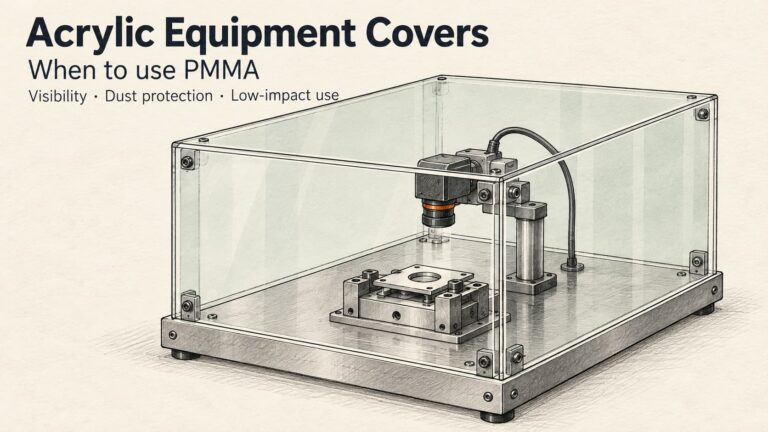
Best starting point for decorative panels, mobile fixtures, colored mirrors, and custom shapes.
Best starting point for fitting rooms, grooming mirrors, and other close-range task reflections.
The short version is straightforward: acrylic mirror is usually the better choice when weight, breakage resistance, decorative color, or custom fabrication matters most. Glass mirror is usually better when image accuracy and scratch resistance matter most.
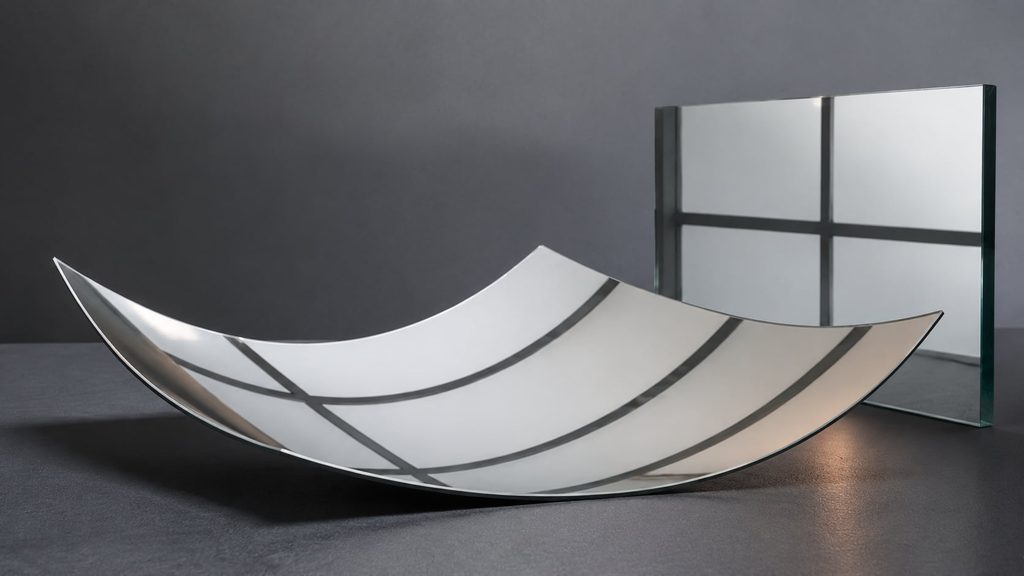
Neither material wins every project. A laser-cut mirrored logo, a portable exhibition wall, and a full-length dressing mirror ask for different things. The useful comparison is therefore not “Which mirror is better?” but “Which compromise fits the job?”
Quick Answer: When to Choose Each Mirror
- The panel will be transported, suspended, or handled repeatedly.
- Reduced breakage risk is more important than perfect image accuracy.
- The design needs cut letters, curves, holes, or decorative mirror colors.
- The reflection is mainly decorative or viewed from farther away.
- People will judge faces, clothing, or body proportions at close range.
- A flatter, more stable reflection is the main requirement.
- The surface will be cleaned frequently or exposed to routine contact.
- The extra weight and glass-specific fabrication are acceptable.
Decision rule: if the reflection itself performs a task, start with glass. If the mirror mainly adds visual depth, branded color, or a fabricated shape, start with acrylic—then check the installed appearance at the required size.
Acrylic Mirror vs. Glass Mirror at a Glance
| Decision Factor | Acrylic Mirror | Glass Mirror | Practical Meaning |
|---|---|---|---|
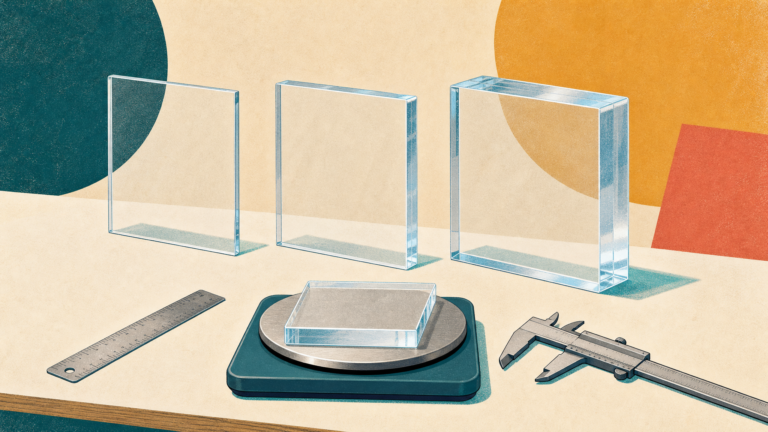
| Weight | Commonly about half the weight at equal size and thickness | Heavier | Affects carrying, doors, mobile fixtures, mounting, and freight |
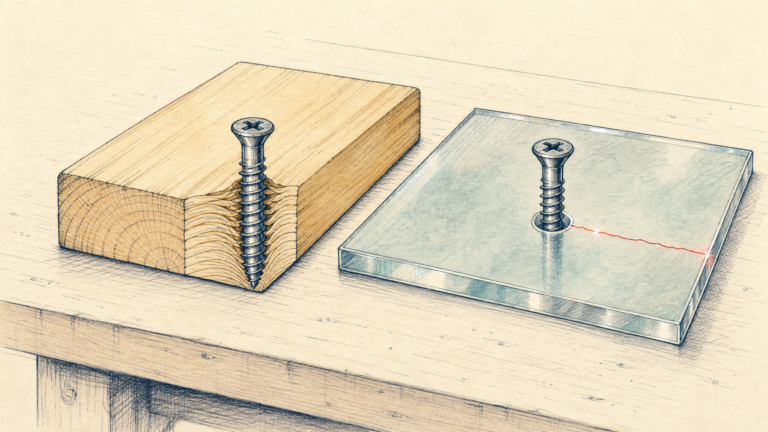
| Breakage behavior | More impact-resistant and less likely to form sharp glass shards | Ordinary glass can fracture; safety constructions are available | Do not treat either material name as a complete safety specification |
| Reflection accuracy | Good for many decorative uses, but more sensitive to flexing | Generally flatter and more stable | Glass has the advantage for close-range task mirrors |
| Distortion risk | Changes with size, thickness, backing, and mounting pressure | Usually lower because glass is more rigid | Large acrylic mirrors should be judged after representative mounting |
| Scratch resistance | Softer surface; careful cleaning required | Harder surface | Glass often suits frequently cleaned public-facing mirrors |
| Fabrication | Easier to laser cut, CNC route, saw, and drill | Requires glass-specific processing | Acrylic supports more custom shapes and drawing-based parts |
| Decorative range | Silver, gold, rose gold, bronze, grey, and other effects | Usually selected for conventional silver reflection | Approve physical color samples under the final lighting |
See the Differences in Motion
The three scenes below turn the comparison into visible behavior: click the steel spheres to compare breakage response, load equal-size panels onto the balance, and change the support conditions to see why acrylic distortion is an installation-sensitive issue.
INTERACTIVE MATERIAL BENCH
Weight, breakage, and reflection—made visible.
Select a scene, then use the controls inside it. Every interaction runs directly in the page.
Watch two different material responses.
Important: this scene compares typical material behavior conceptually. It does not establish an impact rating, break threshold, or compliance result. Safety-backed, laminated, or toughened glass can behave differently from ordinary annealed glass.
Load equal panels onto the balance.
The acrylic planning estimate is about 3.9 kg lower.
The acrylic planning estimate is about 7.9 kg lower.
The acrylic planning estimate is about 13.1 kg lower.
Planning estimates use common nominal densities for PMMA and standard glass. Reflective coatings, safety backing, frames, adhesive, hardware, and packaging are excluded. Confirm finished-part weight before structural or freight decisions.
Watch the acrylic reflection react.
For a decorative mirror, this is the right installation direction—but the final size still needs checking.
Flatten the substrate or improve continuous support before approving the reflection.
Distribute the load, avoid overtightening, or evaluate a more rigid glass mirror.
The animated grid is a conceptual visualization of sensitivity—not a calculated flatness or distortion result. Actual performance depends on mirror grade, thickness, dimensions, backing, mounting, and viewing conditions.
Weight: Acrylic Changes the Handling Plan
At equal size and thickness, acrylic sheet is commonly described as roughly half the weight of glass.[1][2] That difference becomes noticeable long before installation: it affects lifting, hinges, suspended structures, portable displays, packaging, and freight.
The comparison must remain like-for-like. A 6 mm acrylic panel is not “half the weight” of a 3 mm glass mirror simply because both products are mirrors. Compare the finished dimensions, actual thickness, backing, frame, and hardware.
Safety: More Break-Resistant Does Not Mean Unbreakable
Acrylic mirror is more impact-resistant than ordinary mirror glass and does not fail into sharp glass shards in the same way. That is why it is often considered for children’s spaces, exhibition fixtures, mobile installations, decorative ceilings, and areas where transport damage is a concern.
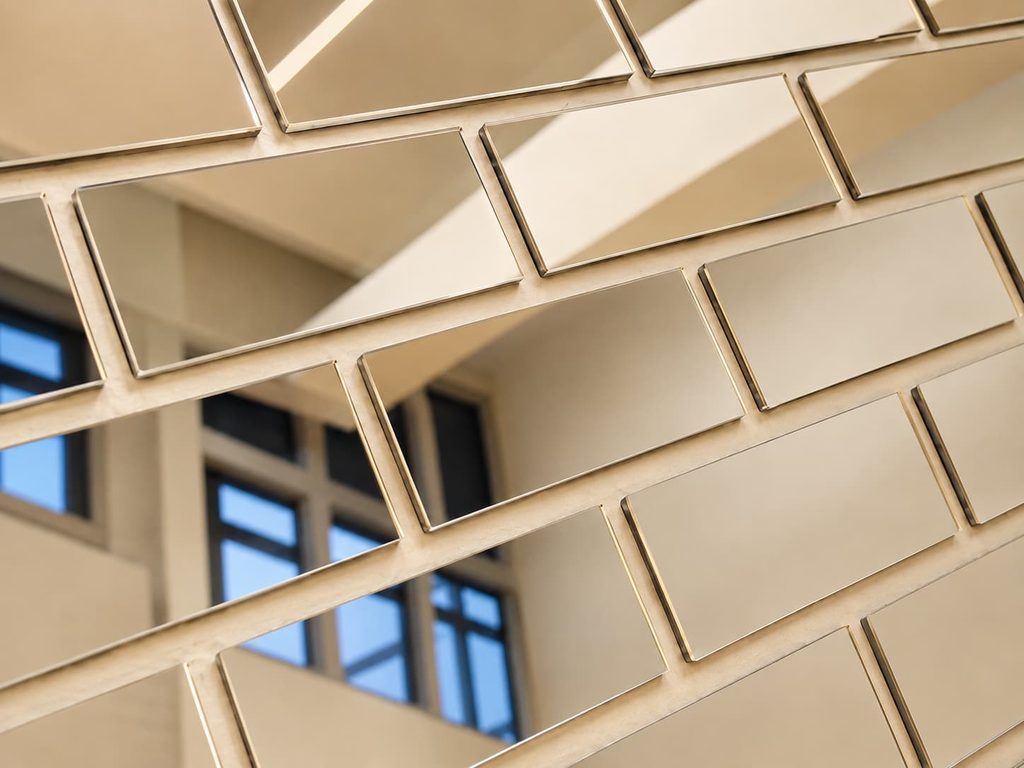
But “shatter-resistant” is the useful phrase—not “shatterproof.” Acrylic can crack, chip, or be damaged, while glass can be safety-backed, laminated, or toughened depending on the product and local requirement.[3] Safety is a construction and installation decision, not a slogan attached to one material.
Clarity and Distortion: Why Glass Usually Looks Flatter
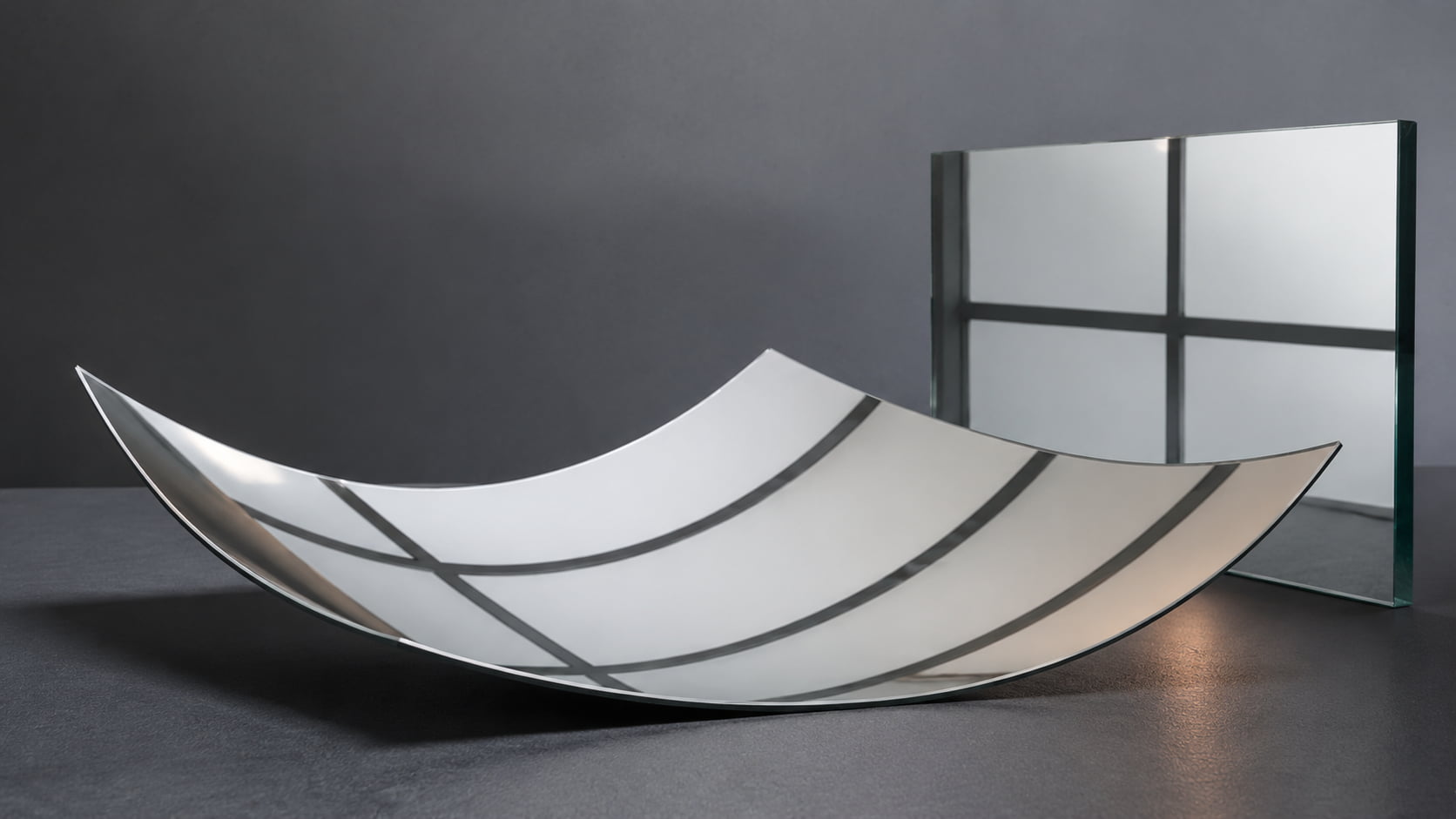
An acrylic mirror can be bright and reflective while still showing a wavy image. The issue is usually not whether the surface reflects light; it is whether the panel remains flat enough to reproduce straight lines and proportions accurately.
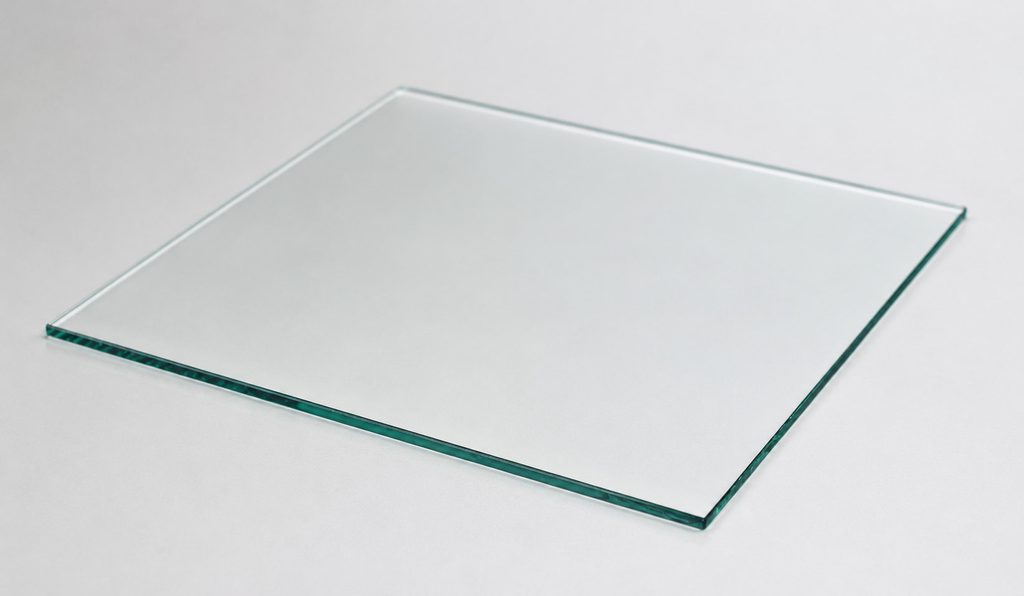
Glass is more rigid, so it generally provides the more stable close-range reflection. Acrylic is more flexible. A large sheet can follow an uneven wall, bow between supports, or dimple around localized adhesive and overtightened fasteners. Plaskolite identifies viewing distance, thickness, flat backing, and mounting as important distortion variables for acrylic mirror.[2]
For decorative inserts and smaller, well-supported parts, acrylic mirror can look convincing. For a full-length mirror, vanity, fitting room, dance studio, or any close-range task, glass is the safer starting point. If acrylic is still required, compare it at the intended size with the proposed backing and mounting—not only as a hand-sized sample.
Surface Care: Glass Tolerates Cleaning Better
Acrylic is softer than glass, so fine scratches are easier to create and easier to see on a reflective surface. This matters in public areas, cosmetic displays, fitting rooms, and fixtures that are cleaned every day.
Use a clean microfiber cloth, mild soap, and water unless the product supplier recommends another method. Avoid abrasive cloths and unapproved window cleaners. The guide to cleaning gold mirror acrylic without scratches covers the same surface-care principle in more detail.
Fabrication: Acrylic Creates More Design Freedom
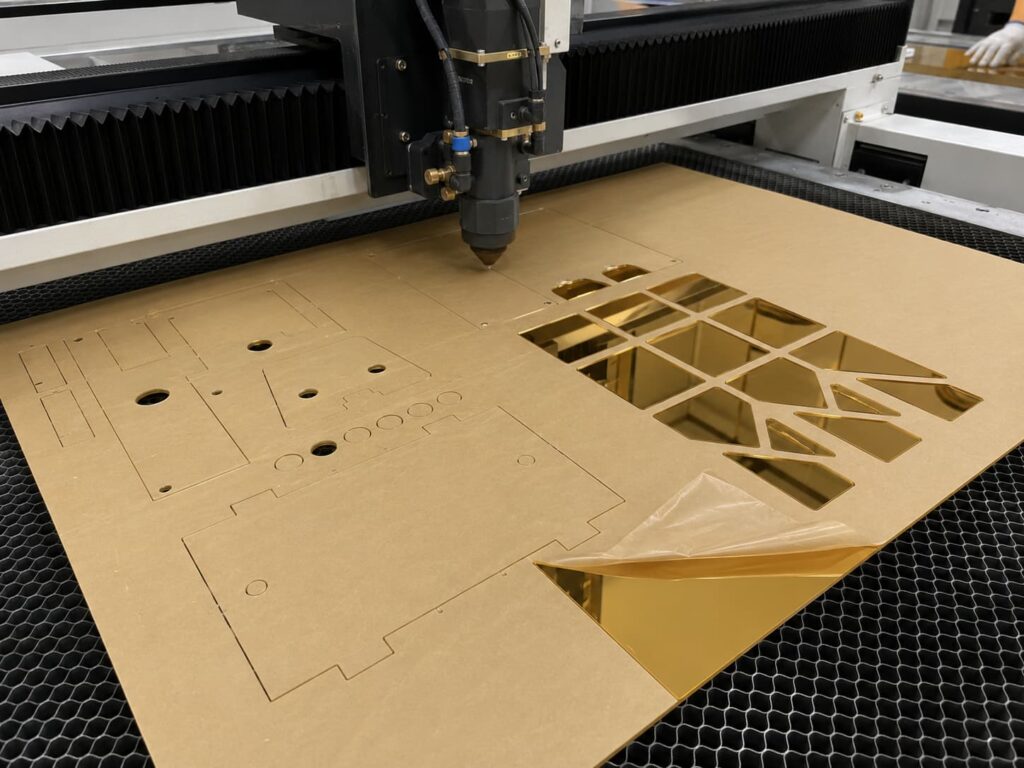
Acrylic mirror is easier to convert into letters, logos, geometric inserts, pierced panels, display components, and drawing-based parts. Depending on the grade and required finish, it can be laser cut, CNC routed, saw cut, or drilled using acrylic-compatible methods.
The reflective backing makes process control important. Heat, damaged masking, incompatible adhesive, poor edge handling, or mounting stress can spoil the visible result even when the dimensions are correct. A clean cut does not automatically guarantee a clean reflection.
Confirm the mirror grade, critical face, backing protection, cutting method, holes, narrow sections, exposed edges, adhesive, and packaging before repeat production. General considerations are covered in the guide to acrylic sheets for laser cutting.
Which Mirror Fits the Application?
Lower weight, cut shapes, and colored finishes usually matter more than perfect close-range image accuracy.
People need an accurate reflection and the surface will usually be cleaned frequently.
Reduced handling weight and lower breakage risk support repeated transport and installation.
Acrylic suits decorative depth; glass may be better where precise face-level reflection is part of the customer experience.
Complex geometry and decorative mirror colors are easier to create from acrylic sheet.
Accurate full-body reflection, safety construction, installation, and local requirements must be considered together.
When a Small Sample Is Not Enough
A small loose sample is useful for checking color, brightness, surface quality, and backing. It cannot show whether a large acrylic panel will remain flat on the intended substrate.
Use a representative installed sample when the panel is large, the viewing distance is close, straight lines will be reflected, the backing or mounting is unusual, or the same result must be repeated across a production batch. For fabricated parts, also approve the first cut component before releasing the full quantity.
What to Send for an Acrylic Mirror Review
MIRROR PROJECT BRIEF
Describe the finished panel—not only the mirror color.
- Application
- Decorative panel, display insert, mobile fixture, task mirror, branded feature, or OEM component
- Panel
- Finished dimensions, thickness requirement, mirror color, and drawing or reference image
- Reflection
- Expected viewing distance and whether the reflection is decorative or accuracy-critical
- Fabrication
- Cutting, holes, edges, printing, bonding, mounting, or assembly requirements
- Order
- Quantity, packaging expectations, and delivery destination
Frequently Asked Questions
Does acrylic mirror give the same reflection as glass?
Not in every application. Acrylic mirror can provide a bright and convincing decorative reflection, especially in smaller or well-supported parts. Glass is generally flatter and therefore more reliable for accurate close-range reflection.
Is acrylic mirror safer than glass mirror?
Acrylic is more break-resistant than ordinary mirror glass and does not create sharp glass shards in the same way. The final safety choice still depends on the product grade, safety backing, mounting, application, and local requirements.
Can acrylic mirror be laser cut?
Many acrylic mirror grades can be laser cut, but the reflective backing, masking, geometry, and edge requirement must be reviewed. A production trial is advisable for repeat or visually critical parts.
Does thicker acrylic mirror reduce distortion?
Greater thickness can increase rigidity, but it is not a universal cure. Panel size, backing flatness, mounting pressure, support, and viewing distance also affect the installed reflection.
Can acrylic mirror be used outdoors or in humid areas?
Only when the selected grade and reflective backing are suitable for the environment. Confirm moisture exposure, edge protection, adhesive, sealing, temperature, and maintenance conditions with the supplier.
Choose the Compromise That Fits the Job
Choose glass when the mirror’s main job is to reproduce an accurate, stable image at close range. Choose acrylic when lower weight, reduced breakage risk, decorative color, or custom fabrication creates more value than maximum reflection accuracy.
For large or visually critical acrylic mirrors, check the finished size, backing, mounting, and viewing distance together. That is not the whole article—it is simply the final step that turns a useful material comparison into a reliable project choice.
SHEET, CUT PART, OR FINISHED COMPONENT
Need acrylic mirror for a commercial or OEM project?
Grandview Acrylic supplies acrylic mirror sheets and drawing-based acrylic components. Send the application, drawing, panel dimensions, mirror color, quantity, and fabrication requirement for review.
Send Your Mirror Project DetailsTECHNICAL SOURCES
References and Further Reading
- [1]PLEXIGLAS® — Load-Bearing Capacity and Weight of Acrylic Sheet
Source: PLEXIGLAS® / POLYVANTIS. Supports the general same-size and same-thickness weight comparison between acrylic sheet and glass.
View Source - [2]FABBACK® Acrylic Mirror Fabrication Guide
Source: Plaskolite. Supports the relevance of viewing distance, thickness, flat backing, mounting, fabrication, and installation to acrylic mirror appearance.
View Source - [3]Glass Standards Overview
Source: Pilkington. Provides a starting point for recognizing that glass safety requirements and constructions vary by application and local standard.
View Source
Mirror coatings, backing systems, safety constructions, thicknesses, fabrication limits, environmental suitability, and finished weights remain product- and project-specific. Confirm the applicable technical data before production.