MATERIAL SELECTION / PMMA × PVC SHEET
“PVC sheet” is three different buying questions.
Clarity, a printable face, and chemical exposure do not point to the same PVC sheet. Name the form before comparing it with acrylic.
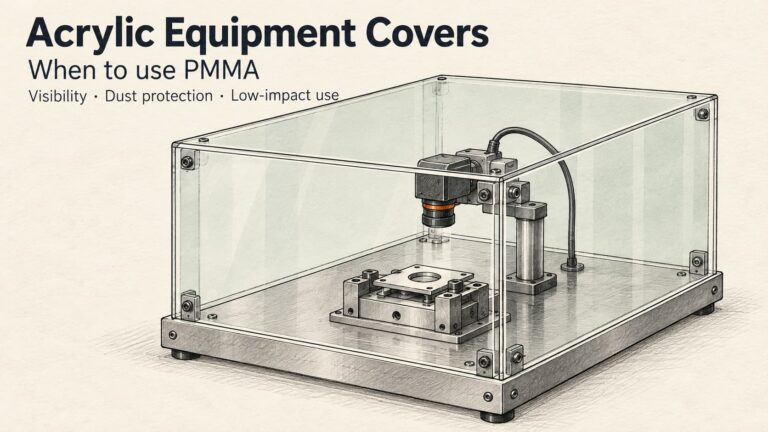
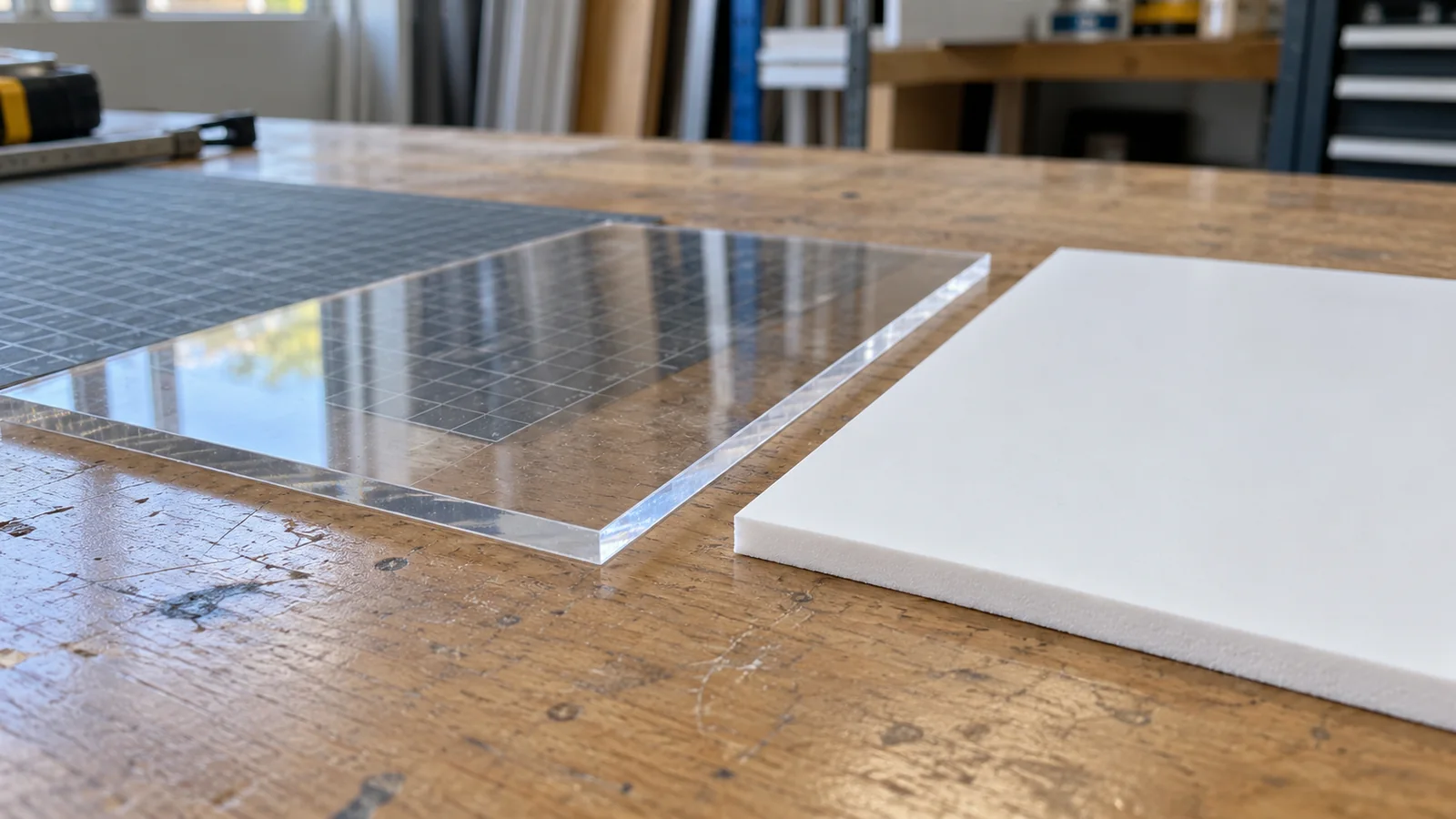
In an acrylic vs PVC sheet comparison, a panel that must show what is behind it and have clean, visible edges often points toward acrylic (PMMA). An opaque printed board may call for expanded PVC. A functional panel exposed to particular chemicals may warrant solid rigid PVC. Clear rigid PVC also exists, so the word “PVC” alone cannot settle the clarity question.
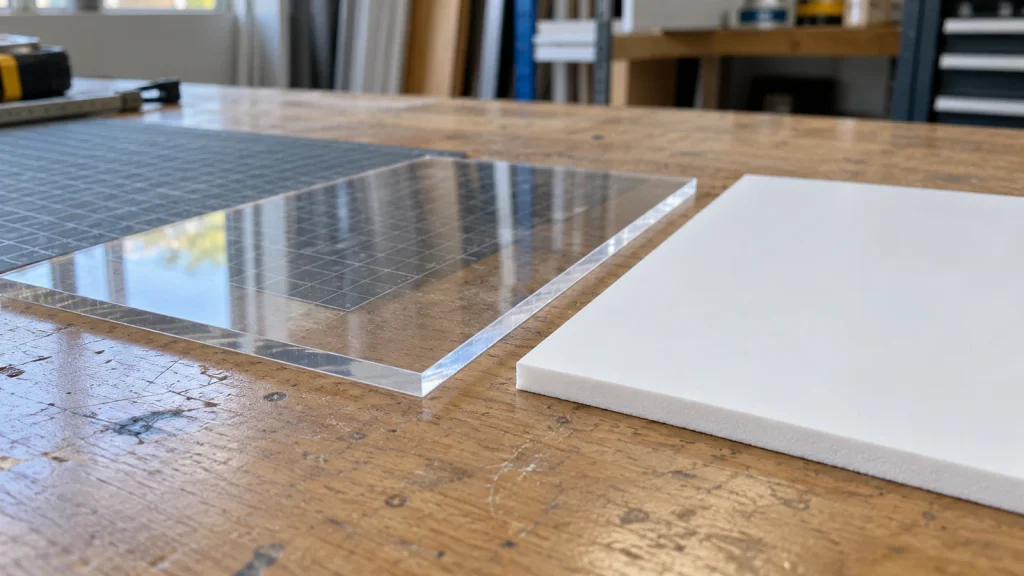
The useful comparison is between specified sheets after the cutting, finishing, mounting, and cleaning the part will actually receive. Here is how to narrow the choice without treating every PVC sheet as the same material.
First, Which PVC Sheet Do You Mean?
This comparison concerns rigid sheets, rather than flexible PVC film or decorative laminates. The four rows below describe different starting points, not interchangeable grades.
| Sheet | Appearance / construction | Sensible starting task | Confirm before approval |
|---|---|---|---|
| Acrylic (PMMA) | Clear, colored, or opaque grades; visible face and edge may be part of the design | Clear cover or edge-sensitive finished part | Grade, thickness, edge, holes, light, and cleaning |
| Expanded PVC | Cellular core and opaque print face [4] | Flat, directly printed board | Print quality, rigidity, mounting, and service life |
| Solid rigid PVC-U | Dense functional sheet; chemical-resistant grades exist [3] | Equipment or functional panel with defined exposure | Exact chemical, grade, process, and UV variant |
| Clear rigid PVC | Transparent PVC-U products exist [2] | Clear panel where a specific PVC grade may suit the job | Through-view, edge, weathering, and processing |
For example, 3A Composites’ FOREX®print is an opaque expanded PVC board made for direct printing; it cannot serve as a see-through cover. SIMONA’s PVC-CAW illustrates a solid PVC-U sheet for chemical equipment, while PVC-GLAS illustrates transparent rigid PVC. A transparent product’s existence does not mean it will look or process like a particular acrylic grade.
Clarity: What Does the Viewer Need to See?
Light transmission measures how much light passes through a sheet. It does not by itself tell you whether fine detail stays sharp, a backlit panel looks even, or a machined edge looks attractive. PLEXIGLAS® product information reports up to 92% visible transmission for certain clear acrylic products.[1] SIMONA lists up to 88% for its PVC-GLAS transparent rigid PVC range.[2] These are product-specific maxima, not a controlled, equal-thickness test of all acrylic against all PVC.
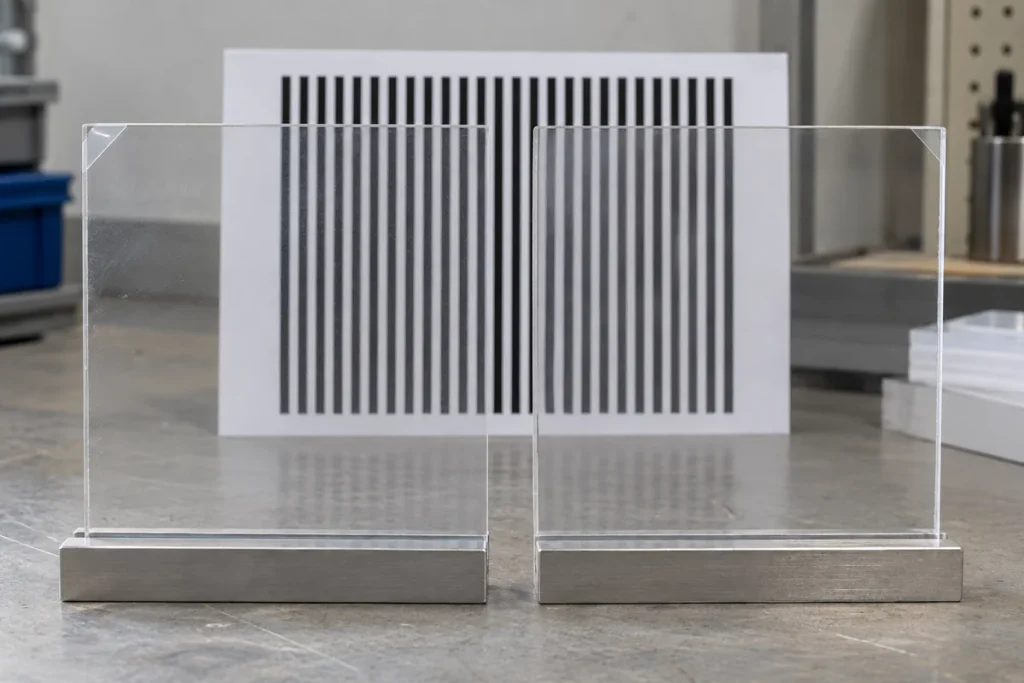
If the part is a transparent cover or a display with exposed edges, begin with a suitable clear acrylic grade. If opaque graphics cover the face, assess print-grade foam PVC on its print result, rigidity, and required life instead. When clear PVC remains a candidate, compare processed samples at the specified thickness under the same conditions.
INTERACTIVE / ONE VIEW TARGET
What sits between the viewer and the target?
Switch the sheet form. Watch the target move behind the panel; then decide what an actual processed sample must prove.
Clear acrylic
The target remains visible. Check the required detail through the face and the real cut or finished edge.
Clear rigid PVC
The target also remains visible. Compare the actual PVC and acrylic grades at equal thickness and processing; this drawing does not rank their clarity.
Expanded PVC
The board hides the target and carries graphics on its face. Judge its print, flatness, mounting, and service life instead of through-view.
One thickness · same light and background · actual edge, print, and assembly.
Conceptual illustration only. Motion shows visibility through a category of sheet, not measured light transmission, haze, impact resistance, or a Grandview material test.
Durability Means More Than One Property
Ask how the part could become unacceptable: yellowing outdoors, a scratch on a frequently cleaned face, cracking around a fastener, or damage from a specific cleaner. These are different tests. A material can pass one and fail another.
For a clear outdoor panel, favor a grade with documented optical weathering and confirm the exposure and warranty conditions. For chemical contact, identify the actual substance, concentration, temperature, contact time, and stress on the part; SIMONA’s PVC-CAW illustrates why solid PVC may be considered for chemical equipment.[3] An ordinary grade and a UV-stabilized version should not be assumed equivalent outdoors. Panel span, supports, and hole positions also affect deflection and breakage. Safety-critical guards require their own impact and design assessment, beyond a general sheet comparison.
Fabrication Can Reverse the Initial Choice
Acrylic can be laser cut when the selected sheet and equipment suit the process; a bright-looking edge may be useful for a visible part. PVC should not enter an ordinary laser-cutting workflow. Trotec’s laser-material guidance lists PVC among materials unsuitable for laser cutting or engraving because processing can produce harmful gases or dust.[5]
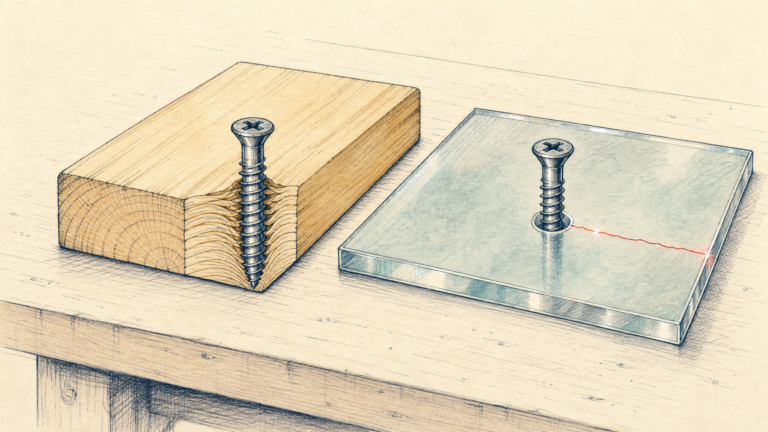
Both candidates may be sawed, routed, or drilled with grade-appropriate tooling, but the finished hole, burr, edge, and assembly fit still need inspection. A glossy acrylic edge may need polishing or a process adjustment; a laser-cut acrylic edge may carry stress that matters during later bonding or solvent contact. A foam PVC panel may suit direct printing, while a clear acrylic part may earn its place through its face and edge appearance. For acrylic process details, see the guide to acrylic sheets for laser cutting.
Where Each Sheet Is a Sensible Starting Point
- See-through cover with a visible edge: Evaluate clear acrylic first, then clear rigid PVC if a documented grade meets the optical, chemical, and process requirements.
- Flat, opaque graphics panel: Evaluate print-grade expanded PVC against opaque or printed acrylic, with the actual print, mounting, and service life in view.
- Functional panel with known chemical exposure: Evaluate a specified solid PVC grade alongside acrylic, then test the chemical and fabricated features that matter.
These are starting points for ordinary sheet parts, not approvals for structural glazing or a certified safety enclosure.
Compare Finished-Part Cost, Not Only Sheet Price
There is no dependable universal price multiple for acrylic versus PVC sheet. Grade, thickness, dimensions, order size, and market change the raw quote. Keep the drawing and acceptance standard constant, then compare the full route to an acceptable part.
| Cost line | What to compare |
|---|---|
| Sheet input | Specified grade, thickness, sheet format, nesting, and usable yield |
| Processing | Cutting, drilling, edge finish, printing, bonding, and inspection |
| Accepted yield | Rejected faces or edges, rework, and parts that pass the defined standard |
| Delivery & service | Surface protection, packing, and expected replacement in the intended use |
For a short-life printed board, paying for clear acrylic and polishing an edge nobody sees may bring no benefit. For a clear cover judged at close range, a cheaper raw sheet can become expensive if its processed face or edge fails inspection. Ask for the cost per accepted part, with each candidate’s grade and process route stated.
Approve the Processed Feature Before Volume Production
A flat swatch only answers a flat-swatch question. Make a sample with the feature most likely to reject the batch, then record the result as the reference for repeat orders.
- Match the proposed grade and thickness. Use the sheet that is actually being considered for production.
- Include the critical feature. Show the visible edge, drilled hole, printed face, bonded joint, or mounted span.
- Check it in use. Review at the real viewing distance and lighting; use the planned cleaner where compatibility matters.
- Keep the approval reference. Record the grade, finish, process, and accepted result for the later order.
Conclusion
Acrylic is usually the first candidate when clear visibility and a refined exposed edge drive the part. Expanded PVC often fits an opaque printed panel; solid rigid PVC can suit a functional panel with a specified chemical requirement; clear rigid PVC is a separate transparent candidate. Name the PVC form, choose a feasible process, and compare the accepted result rather than a generic property list or sheet price.
For the acrylic side of this decision, explore clear acrylic sheets for visible panels or drawing-based acrylic fabrication.
References and Further Reading
- PLEXIGLAS® light transmission — POLYVANTIS. Product-dependent visible light transmission and the difference between transparent and translucent sheets. View source ↗
- PVC-GLAS Sheets — SIMONA. Example of a transparent rigid PVC product and its stated light transmission. View source ↗
- PVC-CAW Sheets — SIMONA. Solid PVC-U product, chemical-equipment applications, and the separately identified UV-stabilized grade. View source ↗
- FOREX®print — 3A Composites. Opaque expanded PVC sheet designed for direct printing. View source ↗
- Materials not suited for laser processing — Trotec. PVC listed among materials not recommended for laser cutting or engraving. View source ↗