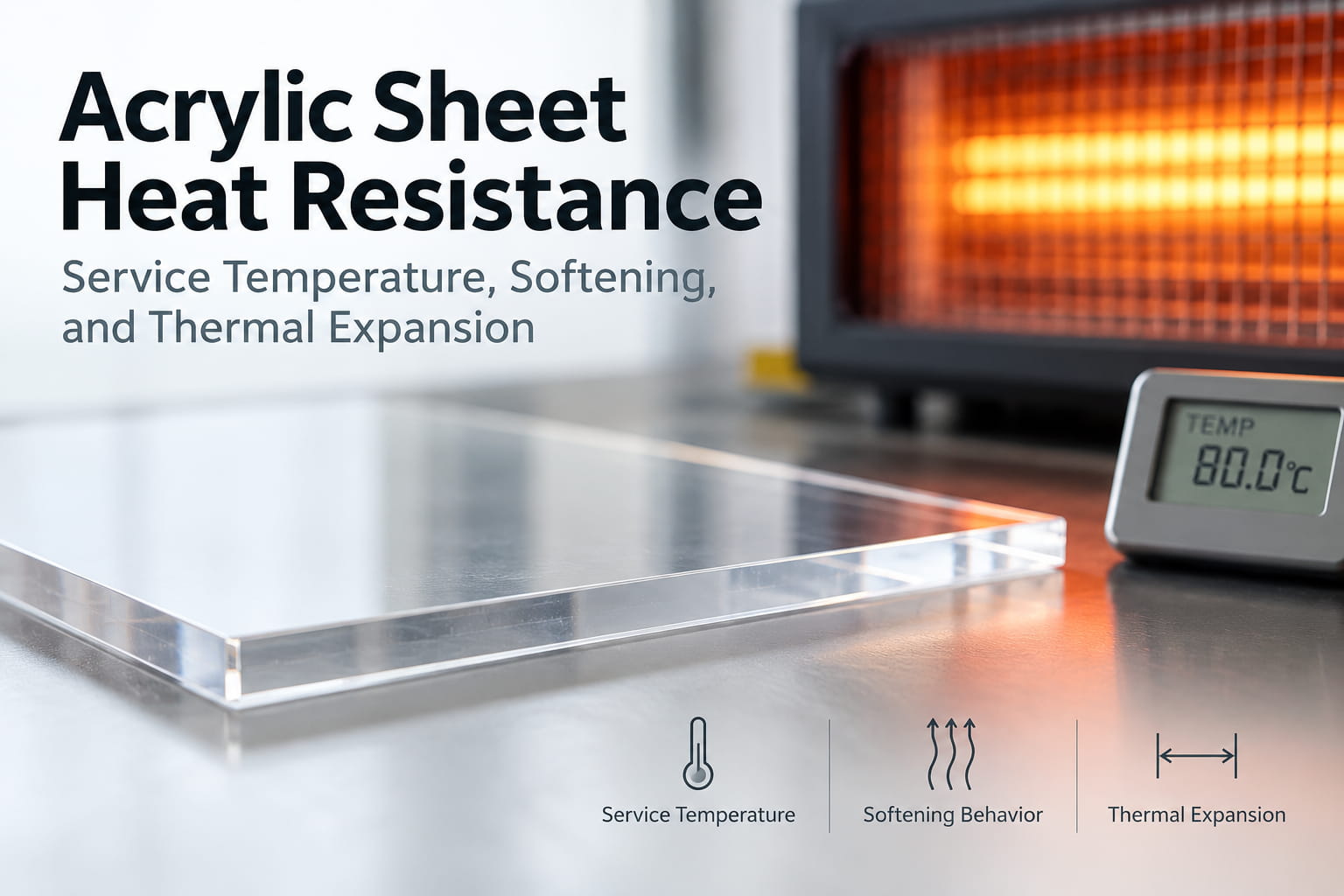
Acrylic sheet can withstand moderate heat, but it starts losing useful rigidity well before it becomes soft enough to reshape. For common grades, published use limits are around 70°C (158°F) for extruded acrylic and 80°C (176°F) for cast acrylic. These figures are useful starting points; the exact limit belongs to the specified grade. [1]
So why do acrylic data sheets also show temperatures above 100°C? And why might a panel bow even when it stays below its recommended limit?
The answers come from two different effects of heat. Acrylic becomes easier to deform as it warms, and it also expands. A successful design must account for both: the sheet needs enough rigidity to hold its shape and enough room to change size.
How Hot Can Acrylic Get Before It Softens?
Acrylic does not remain completely rigid until one temperature, then suddenly turn liquid. Its response to heat is gradual.
PMMA, the polymer used to make acrylic sheet, is an amorphous thermoplastic. As it heats through its glass transition, it changes from a hard, glassy material toward a more flexible, rubbery state. This is why quoting a single “acrylic melting point” tells you little about whether a finished panel will keep its shape. [2]
Different temperature ratings describe different stages or tests of that behavior. Consider these values from one published cast-acrylic data sheet:
On smaller screens, scroll sideways to compare all three columns.
| Property | Published value | What the number means |
|---|---|---|
| Maximum recommended continuous service temperature | 82°C180°F | The recommended ceiling for sustained use under the applicable conditions. |
| Heat deflection temperature (HDT) | 99°C210°F · at 264 psi | A heated specimen reaches a specified amount of bending under load. |
| Vicat softening temperature | 115°C239°F | A loaded test needle penetrates the heated material to a specified depth. |
These are typical values for the material in that document, principally at 6 mm thickness—not universal acrylic specifications. [3]
The numbers are consistent because the tests ask different questions. HDT measures bending during a controlled heating test; Vicat measures resistance to indentation. Neither establishes how long an installed panel will remain acceptably flat. Test load and procedure also matter when comparing materials. [4] [5]
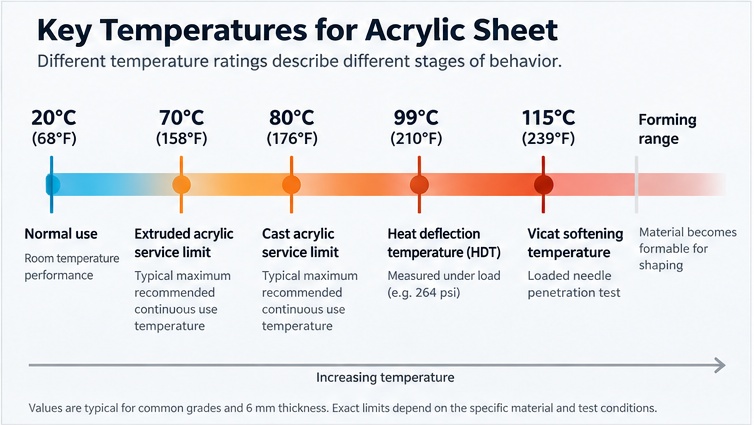
For everyday use, start with the continuous service temperature. Choosing the highest temperature printed on the sheet would confuse a softening test with a working limit.
Fabrication temperatures answer another question entirely. Acrylic is deliberately heated until it becomes formable, then shaped and cooled. The ability to undergo that process does not mean a finished component can operate at the same temperature.
Why a Panel Can Sag Below Its Temperature Limit
A service temperature is not a promise that acrylic will retain its room-temperature strength right up to that number.
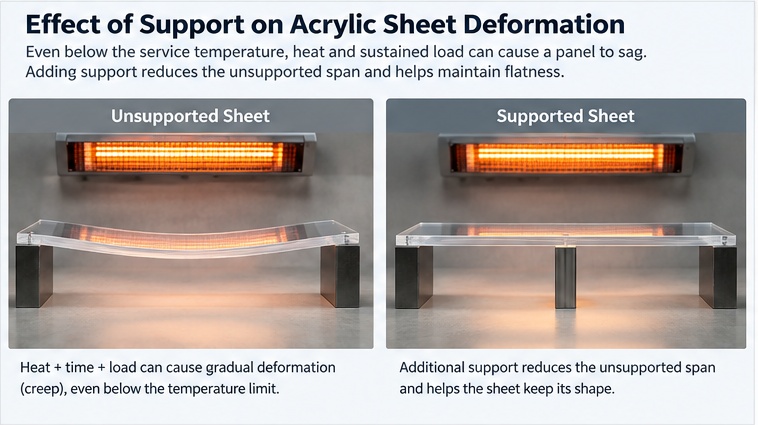
As the material warms, it becomes less resistant to deformation. Sustained loading adds another effect: creep, the gradual change in shape under a force that remains in place. Even a sheet’s own weight can cause deformation if it lacks adequate support. [3]
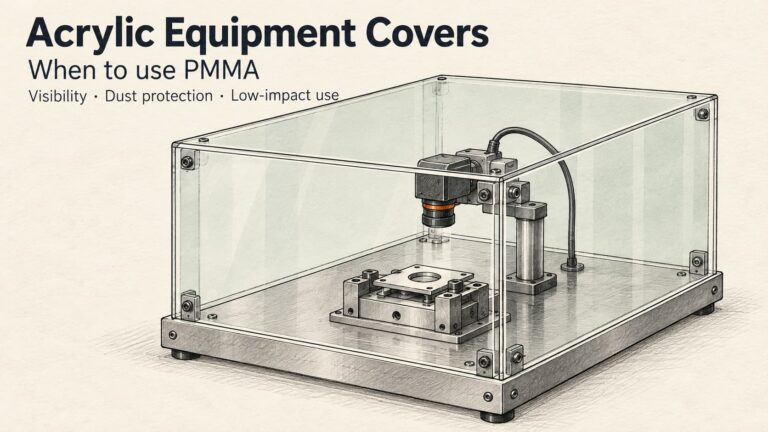
Consider a thin horizontal equipment cover. Its unsupported center has to carry its own weight. A short warm-up might produce no obvious change, while a longer period of operation gives deformation more time to develop. Adding support reduces the unsupported span and changes how much bending the sheet must resist.
This explains why increasing thickness sometimes helps a heat-related problem. A thicker sheet resists bending more strongly, but thickness does not turn the same acrylic grade into a higher-temperature material. Panel dimensions, geometry and support remain part of the decision. [6]
Also, use the temperature of the acrylic itself when assessing exposure. Air outside an enclosure does not reveal the temperature of a panel close to an internal heat source. For a working prototype, measure the hottest relevant areas after the equipment has warmed up.
Thermal Expansion Happens Before Acrylic Feels Soft
Acrylic does not need to approach its softening temperature to change size. It expands during ordinary warming and contracts as it cools.
For several standard acrylic grades, a published coefficient of linear thermal expansion is approximately 0.000072 per °C. In practical terms, a one-meter length grows about 0.072 mm for each 1°C temperature rise. [7]
Take a one-meter panel warming uniformly from 20°C to 60°C. Its calculated free expansion is:
1,000 mm × 40°C × 0.000072/°C = 2.88 mm
That is only about 0.29% of its length, yet almost 3 mm matters in a close-fitting frame. A two-meter panel under the same conditions would grow about 5.76 mm.
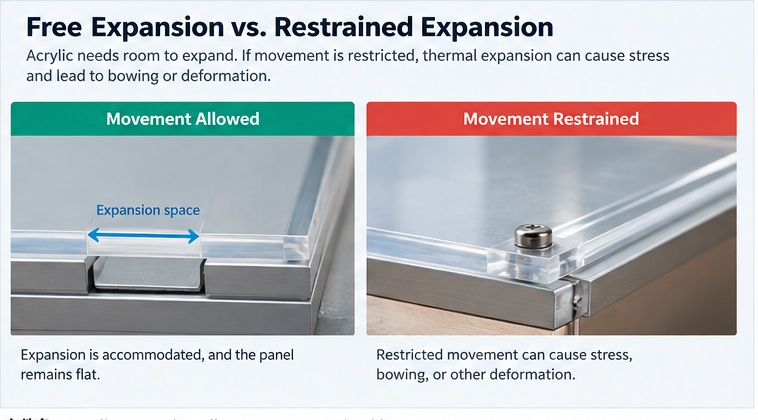
If the mounting allows movement, the panel can accommodate that growth. If the edges or fixings prevent it, expansion creates stress and can cause bowing or damage around restrained areas. This gives a second explanation for a distorted panel: the material may still be sufficiently rigid, but its installation leaves nowhere for the extra length to go.
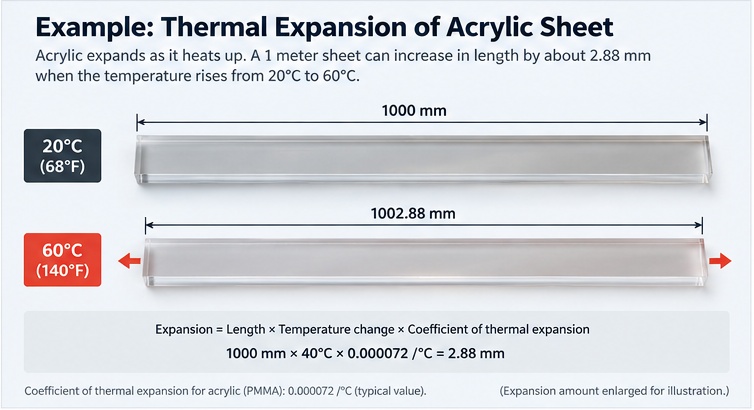
The calculated 2.88 mm is the total free length change in this example. Turning it into an installation allowance requires accounting for where the panel is fixed, how the frame moves, and manufacturing tolerances; humidity can add further dimensional change. It is not automatically a gap to leave at every edge.
Choosing Acrylic for a Warm Environment
The useful choice follows from the cause of the problem.
If the sheet’s operating temperature approaches its grade’s continuous limit, reducing heat exposure or selecting a material with a suitable higher service rating takes priority. Greater distance from the heat source or improved ventilation may resolve the exposure. Adding thickness alone does not.
If the temperature is suitable but the sheet sags under load, review its thickness, unsupported span and support arrangement. If a panel bows as it warms inside a tight frame, review its freedom to expand before simply ordering a thicker replacement.
Cast acrylic generally offers more temperature headroom than standard extruded acrylic, as the use limits above illustrate. That makes cast worth evaluating when heat narrows the choice, but “cast” alone is not an approval for the application. Use the actual grade’s service data together with the assembly conditions.
For a production project, test a representative finished part with the intended mounting and load. Observe its flatness and fit both during operation and after cooling. This connects the material data to the result that matters: whether the part continues to do its job. A brief successful trial does not establish long-term performance.
An inquiry to Grandview Acrylic is most useful when it includes the expected panel temperature and exposure duration, plus a drawing showing thickness and mounting. Those details explain the heat requirement far better than “heat-resistant acrylic.”
Conclusion
Acrylic heat resistance depends on more than avoiding visible softening. The working temperature determines how much rigidity remains; time and loading affect deformation; thermal expansion determines how much movement the installation must accommodate. Understanding those relationships makes it easier to choose both the sheet and the design that will support it.
References and Further Reading
- Temperature behavior PLEXIGLAS. Published use limits for GS cast and XT extruded acrylic. View source
- Forming PLEXIGLAS PLEXIGLAS. Temperature-related material behavior and forming principles. View source
- Cast Acrylic Sheet (GP): Physical Properties Technical sheet hosted by Interstate Plastics. Service, HDT and Vicat values (page 7); loading and deformation (page 2). View source
- Heat Deflection Temperature ASTM D648, ISO 75 Intertek. What a heat deflection test measures. View source
- Vicat softening temperature for plastic pipes ZwickRoell. Explanation of the Vicat indentation method and its relationship to ISO 306. View source
- Load-bearing capacity PLEXIGLAS. The role of dimensions and geometry in sheet selection. View source
- Expansion and contraction of acrylic ACRYLITE. Linear expansion coefficients and the calculation method used in the example. View source