CHOOSE THE JOB BEFORE THE FINISH
The finish is only the beginning.
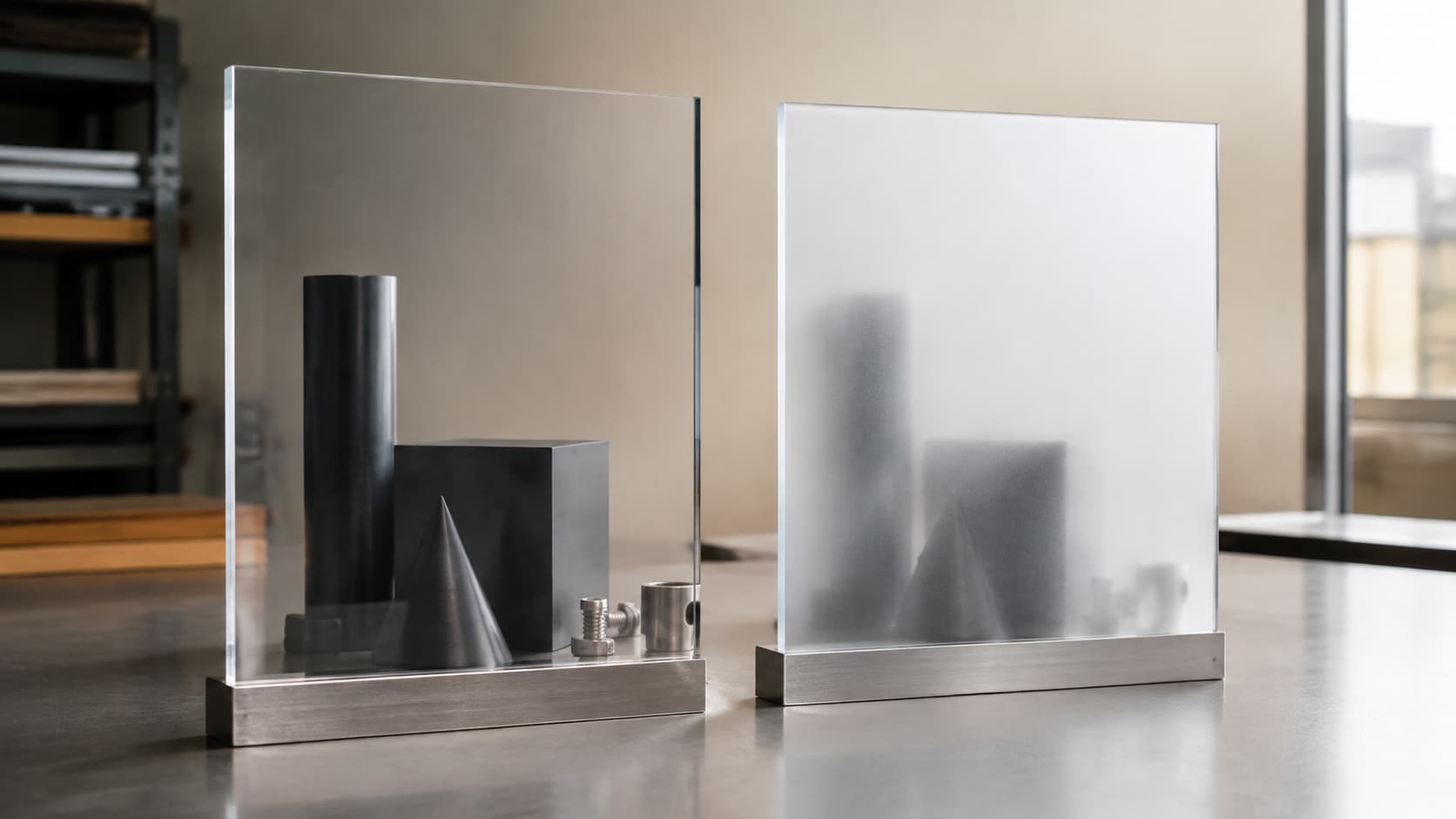
Clear keeps the view open. Frosted softens it. The final choice is made by the installed lighting, viewing distance, surface direction, and fabrication—not by a loose sample alone.
Clear shows the subject. Frosted shows the light. Privacy is proven in the installed condition.
- Need detail?
- Start with clear.
- Need light without detail?
- Start with frosted.
- Need LEDs to disappear?
- Test a diffuser grade.
Clear keeps the view open. Frosted softens it. That sounds like an easy choice—until the panel is backlit, placed close to the object it should hide, printed on one side, or polished around the edge.
For a display case, privacy partition, cabinet insert, machine guard, or illuminated component, the right choice depends on more than how a sheet looks on a sample table. It depends on what people must see, how the panel will be lit, which face points toward the viewer, and what fabrication does to the finish.
Quick Answer: Choose for the Job the Panel Must Do
Choose clear acrylic when people must read, inspect, identify, or present what is behind the panel.
Choose frosted acrylic when light should still pass through but fine detail should be softened or concealed.
If the purpose is to hide individual LEDs or create controlled illumination, do not assume that any frosted sheet will work. Test an appropriate acrylic light diffuser with the actual light source, LED spacing, cavity depth, and viewing distance.
| Project Question | Clear Acrylic | Frosted Acrylic |
|---|---|---|
| Must details remain readable? | Better starting point | Poor fit if fine detail matters |
| Is partial privacy required? | No | Better starting point, subject to testing |
| Desired reflection | Sharper and glossier | Softer with many matte textures |
| Handling marks | Often easier to notice | Some finishes make light marks less obvious |
| Surface direction | Usually simpler | Specify it for one-sided material |
| Lighting role | Preserves visibility | May soften light; not automatically a diffuser |
| Sample approval | When appearance is critical | Under the installed light and background |
“Clear” and “frosted” describe a visual direction; neither is a complete material specification.
“Frosted” Is Not a Complete Specification
Writing only “frosted acrylic” in an email or drawing leaves important questions unanswered:
- Is the sheet frosted on one side or both sides?
- Which face is customer-facing?
- Is the reverse face smooth, textured, printed, bonded, or protected?
- How much detail must it conceal, and from what distance?
- Is the goal privacy, a matte appearance, or controlled light diffusion?
- What finish reference will be used for approval?
Terms such as frosted, matte, satin, and non-glare are not universal finish codes. The name alone does not guarantee an equivalent appearance between products or repeat orders. Manufacturer product lines also distinguish between one-sided and two-sided textures, so the exact surface construction should be checked rather than inferred from a generic label.[2][3]
For one-sided material, orientation can affect appearance, cleaning, printing, and bonding. The drawing should identify the visible face and frosted side instead of leaving the fabricator to guess.
Buyers comparing available options can review Grandview’s frosted acrylic sheet options and clear acrylic sheet specifications as separate product categories. The final specification should still be confirmed against the selected material and sample.
Privacy Depends on Distance, Lighting, and Contrast
A frosted panel does not have one fixed “privacy level.” Its effect changes with the installation.
If a person stands close to a strongly backlit partition, the outline may remain obvious. Move the person farther away or change the lighting, and the same sheet may conceal much more detail.
PRIVACY VALIDATION
Test one sample in four installed conditions.
This is a conceptual test plan, not material performance data. Keep the sheet, camera position, and intended viewing distance consistent.
Check whether edges, text, hardware, or facial features remain recognizable.
Check whether contrast, silhouettes, or movement become visible again.
Check whether the intended separation is achieved at the real viewing distance.
Check whether strong background light still reveals an unacceptable outline.
A loose swatch cannot prove privacy. Test the approved thickness against the real—or realistically simulated—background, light direction, viewing distance, and object distance. If those conditions are not fixed, share the application and a reference image before asking for the “most private” sheet.
Light Transmission, Diffusion, Glare, and LED Hotspots Are Different
These four ideas are often collapsed into one word: light. They should not be.
- Transmission
- How much light passes through?
- Haze or diffusion
- How is that light scattered?
- Glare reduction
- How are reflections or viewed sources perceived?
- Hotspot control
- Do individual LEDs remain visible?
ASTM D1003 covers measurement of haze and luminous transmittance for transparent plastics. They are not interchangeable: a panel can transmit light while scattering it strongly, or remain visually clear without hiding a concentrated source.[1]
A general frosted surface may soften reflections and obscure detail, but it does not automatically provide the diffusion required by a lightbox. Hotspot visibility also depends on LED pitch, panel distance, brightness, internal reflection, and viewing angle. Dedicated diffuser ranges illustrate why lighting performance is treated as a separate material task.[4]
For a broader explanation of optical categories, see transparent, translucent, and opaque acrylic sheets.
Surface Finish Changes Handling—Not the Laws of Maintenance
Smudges, dust, and fine marks are often easier to see on a glossy clear surface. A textured finish may make some marks less noticeable by breaking up reflections. That does not make every frosted sheet more scratch-resistant.
A finish can hide a mark without resisting the mark. “Less visible” is not the same as “more scratch-resistant.”
For frequently touched partitions, cabinet fronts, or equipment covers, consider cleaning frequency, exposure to tools or packaging, and whether dust or grease can collect in the texture.
Use a soft, non-abrasive cloth and a cleaner suitable for the selected acrylic grade. Unsuitable solvents, abrasive pads, and dry wiping can damage the surface. Material-manufacturer care guidance also recommends cleaning methods appropriate to acrylic rather than treating it like ordinary glass.[5] For high-contact projects, test cleaning on the exact finish rather than judging it from a photograph.
Fabrication Can Change the Final Appearance
Cutting, polishing, bending, bonding, and printing can introduce glossy areas, transparent edges, visible joints, or changes in texture.
Cut and Polished Edges
A polished edge beside a frosted face becomes clearer and glossier. If the edge remains visible, include it in the approval sample.
Laser cutting and CNC machining leave different edge conditions. The method should follow the thickness, geometry, tolerance, edge requirement, and acrylic grade—not the word “frosted” alone.
Bending and Thermoforming
Heating and stretching can change texture around a bend. The result depends on grade, forming conditions, geometry, and tool-contact face. Manufacturer guidance for textured acrylic confirms that forming should be evaluated by grade and process rather than assumed from the flat sheet.[6] Use a formed sample when appearance matters.
Bonding and Printing
Adhesive can visibly alter a matte face. Judge a bonded corner as a finished joint, not only for strength and alignment.
Ink, white backing, print position, and the choice of smooth or textured face can change contrast and light behavior. Define the viewing and print sides before production. Grandview’s custom acrylic printing page covers the process separately.
Which Finish Fits the Application?
| Application | Better Starting Point | Verify Before Ordering |
|---|---|---|
| Display case or inspection window | Clear | Required clarity, reflections, edge finish, cleaning, and viewing angle |
| Privacy partition or cabinet insert | Frosted | Object distance, backlighting, two-way viewing, and frosted-side orientation |
| Retail fixture base or product backdrop | Frosted or combined | Whether the product or panel should attract attention; print and lighting interaction |
| Protective cover or machine guard | Clear where observation is required | Sight lines, safety requirements, thickness, mounting, and exposure conditions |
| Decorative interior panel | Frosted | Texture reference, touch frequency, background color, and visible edges |
| Illuminated sign or lightbox component | Tested diffuser or project-specific grade | LED spacing, cavity depth, hotspot visibility, brightness, and print layers |
| OEM fabricated component | Project-specific | Drawing, visible face, machining, joints, tolerance, sample, and packaging |
Clear and frosted do not always compete. One assembly may use a clear cover to preserve visibility and a frosted base to soften reflections or conceal hardware. Choose for each surface, not necessarily for the whole assembly.
Approve the Installed Effect, Not Just the Sheet Name
For a visually sensitive project, approve a sample that represents the finished condition as closely as practical.
- 01
Approve the actual sheet
Record the material, finish reference, thickness, color, and one- or two-sided texture.
- 02
Recreate the installed condition
Use the intended background, light direction, viewing distance, and distance to objects or LEDs.
- 03
Include the critical fabrication
Add the polished edge, bend, print, or bonded joint that will affect the visible result.
- 04
Lock the approved reference
Record the visible face, sample ID, approval date, and reference for repeat production.
This avoids a familiar production problem: everyone approves the word frosted, but each person imagines a different finish.
Structural decisions remain separate. Select thickness with panel size, rigidity, support, mounting, and fabrication in mind. See the acrylic sheet thickness guide for that decision.
What to Include in a Clear or Frosted Acrylic RFQ
A useful RFQ should remove the assumptions that affect appearance. Provide:
- Application: drawing or reference image, plus what people must see or conceal
- Finish: clear or frosted direction, finish code or physical reference, and visible face
- Size: thickness, overall dimensions, and quantity
- Installed condition: frontlit, backlit, edge-lit, or ambient light; object or LED distance where relevant
- Fabrication: cutting, polishing, bending, bonding, printing, or assembly
- Delivery form: whole sheets, cut-to-size blanks, or finished components
FINISH + DRAWING REVIEW
Send the conditions the word “frosted” cannot describe.
Share the application, finish direction, visible face, installed lighting, dimensions, fabrication, and quantity. For appearance-critical work, request a processed sample that reflects the installation.
Frequently Asked Questions
Does frosted acrylic provide complete privacy?
Not automatically. It depends on grade, thickness, object and viewing distances, contrast, and lighting. Strong backlighting can reveal silhouettes even when fine detail is obscured. Test realistic installed conditions.
Is one-sided or two-sided frosted acrylic better?
Neither is universally better. One-sided material can provide a textured viewing face and a smooth reverse face for printing, bonding, or cleaning. Two-sided material may create a more consistent effect from both directions. Confirm the product structure before specifying it.
Can frosted acrylic hide LED hotspots?
It may soften them, but ordinary frosted acrylic is not automatically a diffuser. LED spacing, panel distance, brightness, internal reflection, and formulation all matter. Test the complete lighting assembly.
Is frosted acrylic more scratch-resistant than clear acrylic?
Not as a universal rule. Texture may make fine marks less visible, but scratch resistance is a separate property tied to the specific grade or coating.
Can frosted acrylic be laser cut, polished, bent, bonded, or printed?
Many products can be fabricated, but the process may change the visible finish. Confirm grade compatibility and approve polished edges, formed areas, printed faces, or bonded joints when appearance matters.
Conclusion: Approve the Effect Where It Will Be Used
The clear-versus-frosted decision begins with one question: must the panel show detail, or soften it? A reliable specification then defines surface direction, installed lighting and distances, visible edges and joints, cleaning, and fabrication.
Choose clear when the subject must remain visible. Choose frosted when light should remain but detail should recede. Choose a tested diffuser when the lighting system—not just the panel surface—must be controlled.
Above all, approve the effect in the condition where it will be used.
FROM FINISH NAME TO APPROVED PART
Show what must remain visible—and what should recede.
If you are sourcing acrylic sheets, cut blanks, or fabricated parts, send the application, material direction, visible face, dimensions, lighting condition, processing requirements, and quantity.
Prepare a Clear or Frosted Acrylic RFQTECHNICAL SOURCES
References and Further Reading
- [1]ASTM D1003 — Standard Test Method for Haze and Luminous Transmittance of Transparent Plastics
Source: ASTM International. Supports the distinction and measurement context for haze and luminous transmittance.
View Source - [2]PLEXIGLAS® Satinice — Textured Acrylic Surfaces
Source: PLEXIGLAS® / POLYVANTIS. Provides manufacturer context for textured acrylic surface families and their visual and handling characteristics.
View Source - [3]ACRYLITE® Satinice — Velvet Texture Extruded P95
Source: ACRYLITE®. Supports the need to distinguish a specific textured surface and product construction from the generic word “frosted.”
View Source - [4]ACRYLITE® Satinice — Optimum Light Diffusion
Source: ACRYLITE®. Supports treating controlled light diffusion as a grade-specific lighting task rather than a universal property of every frosted surface.
View Source - [5]Recommendations for the Care and Cleaning of Acrylic Sheet
Source: ACRYLITE®. Supports using acrylic-compatible cleaners and soft, non-abrasive cleaning methods.
View Source - [6]Can ACRYLITE® Satinice Acrylic Sheet Be Thermoformed?
Source: ACRYLITE®. Provides grade-specific context for forming textured acrylic and evaluating the finished surface after heating.
View Source
Surface appearance, privacy, light behavior, fabrication results, tolerance, and product availability remain grade-, thickness-, equipment-, and project-specific. Confirm the selected material, drawing, installed condition, and processed sample before production.