B2B OPTICAL ACRYLIC SELECTION GUIDE
Choose acrylic by what the project needs viewers and light to see—not by color names alone.
A clear product cover, a glowing lightbox panel, and a solid branded backdrop may all use acrylic. The right category depends on whether the finished part must reveal detail, diffuse light, or conceal what is behind it.
QUICK BUYER DECISION
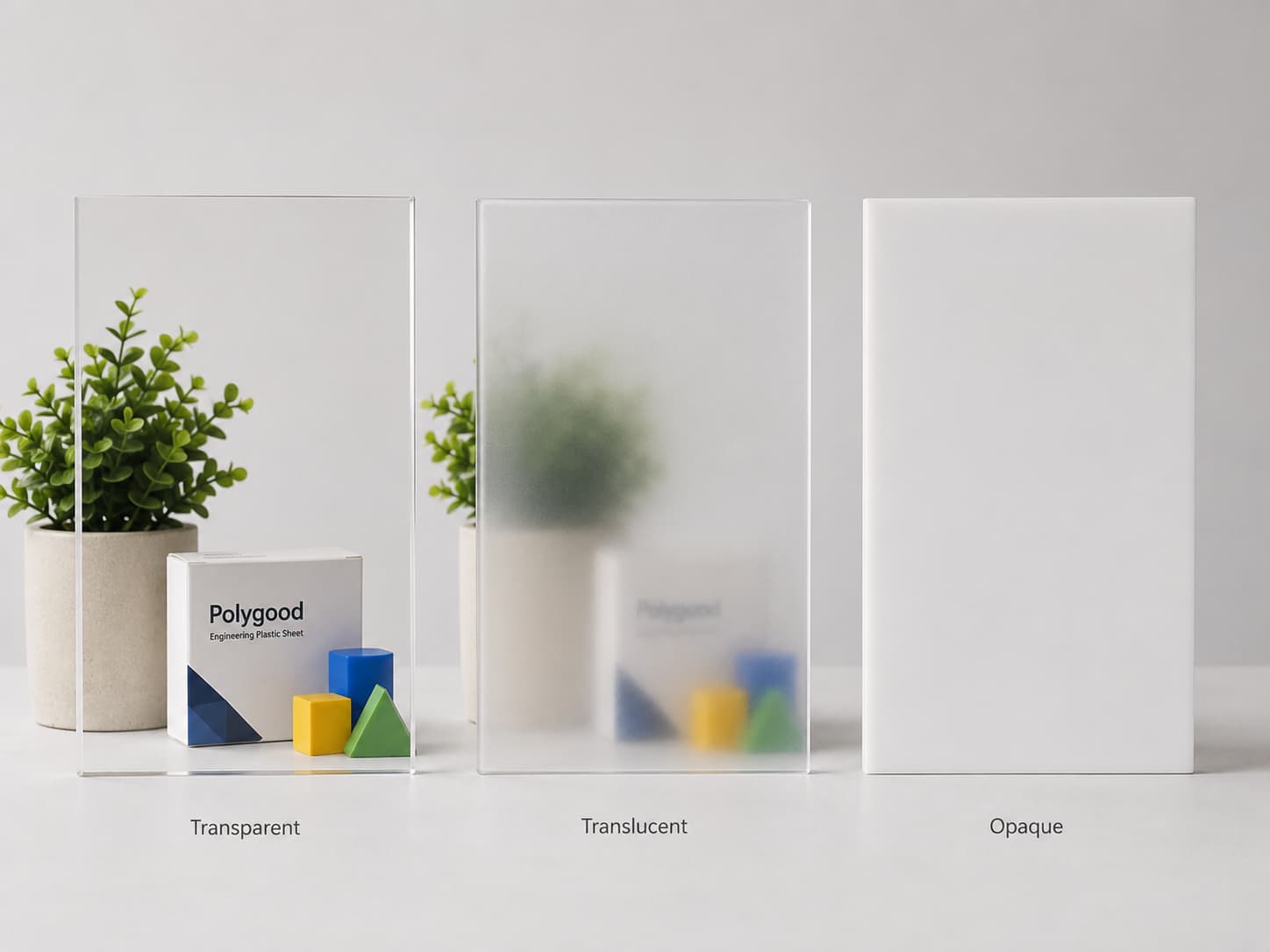
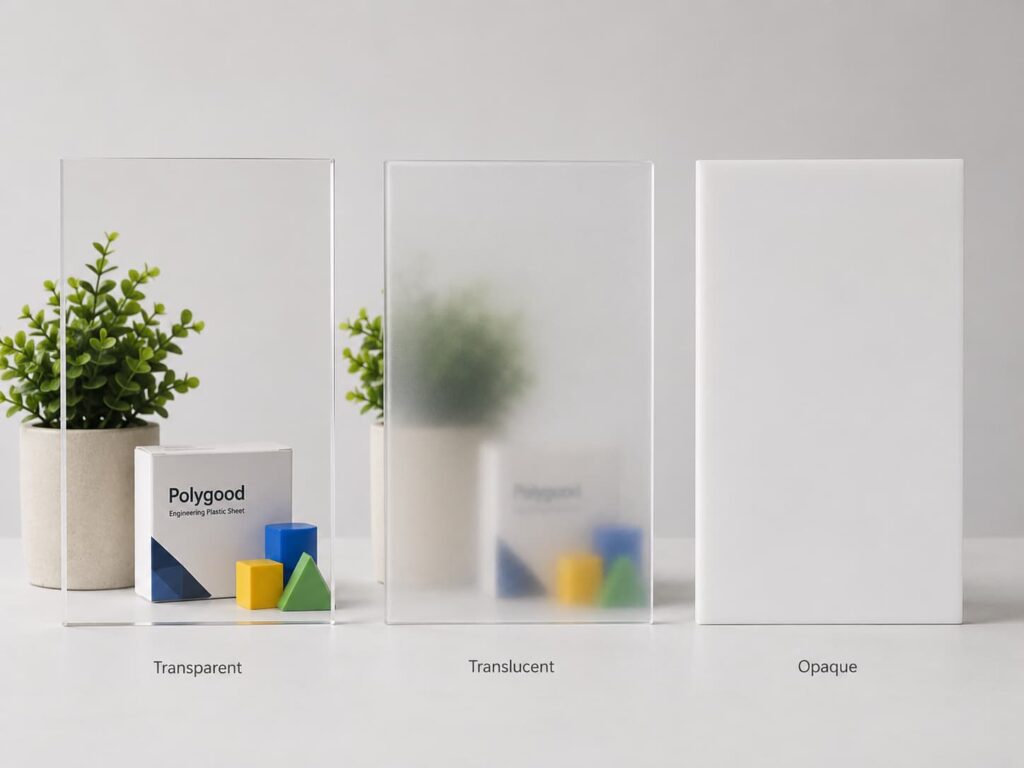
Transparent shows what is behind the sheet. Translucent shows the light, not the detail. Opaque shows only the surface.
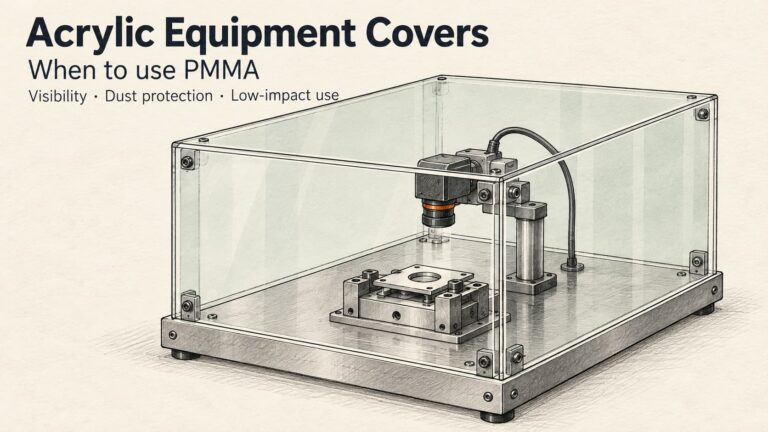
- Transparent: product visibility, clear guards, covers, enclosures, and showcase parts.
- Translucent: lightboxes, illuminated panels, privacy screens, and diffusers.
- Opaque: solid brand panels, bases, housings, and internal-structure concealment.
- Before bulk production: confirm thickness, color, lighting, surface finish, and fabrication on a physical sample where practical.
Transparent vs Translucent vs Opaque Acrylic: What Changes?
These terms describe how light and visual detail pass through a sheet. Transparent materials keep contours relatively sharp; translucent materials transmit light while making contours indistinct.[1] Opaque acrylic is used when useful visibility through the part is not required.
| Category | Viewer sees | Light behavior | Typical B2B purpose |
|---|---|---|---|
| Transparent | Objects and detail | Passes with limited diffusion | Display covers, guards, transparent enclosures |
| Translucent | Shapes or glow, not clear detail | Passes and diffuses | Lightboxes, sign faces, privacy panels |
| Opaque | Only the front surface | Substantially reduced or blocked | Brand backdrops, bases, housings, solid panels |
Decision rule: If the viewer must see the product, start with transparent. If the project needs a glow without a clear view, start with translucent. If the design must hide the background or hardware, start with opaque.
Transparent Acrylic Sheets
Transparent acrylic sheets suit retail display covers, cosmetic cases, machine guards, protective panels, brochure holders, and exhibition parts. For customer-facing components, buyers should also review scratch visibility, exposed edges, thickness, printing, mounting, and protective masking. See our guide to clear acrylic sheets for display manufacturing for more on clarity and finishing.
Translucent Acrylic Sheets
Translucent acrylic is used when the project needs transmitted light, softened visibility, or partial privacy. Final appearance depends on pigment, thickness, light source, LED layout, cabinet depth, graphics, and ambient light. Material guidance from ACRYLITE notes that perceived color varies with transmitted and reflected light and should be evaluated under intended end-use conditions.[2]
Pro Tip
Approve translucent acrylic at the intended thickness and under the real lighting condition. A flat sample that looks uniform in daylight may reveal LED hot spots, internal hardware, or a different color once backlit.
Opaque Acrylic Sheets
Opaque acrylic creates a solid visual surface for display bases, brand backdrops, fixture cladding, housings, machine covers, and non-illuminated graphic panels. Specify more than a color name: gloss level, matte or frosted finish, edge color, printing method, fingerprint visibility, and cleaning requirements can all affect the finished part.
Optical Category Is Not the Same as Color or Surface Finish
Transparent, translucent, and opaque describe light behavior. Clear, colored, white, black, frosted, satin, and matte describe color or appearance. A colored acrylic sheet may belong to any of the three optical categories, and “frosted” alone does not define an exact diffusion or privacy level.
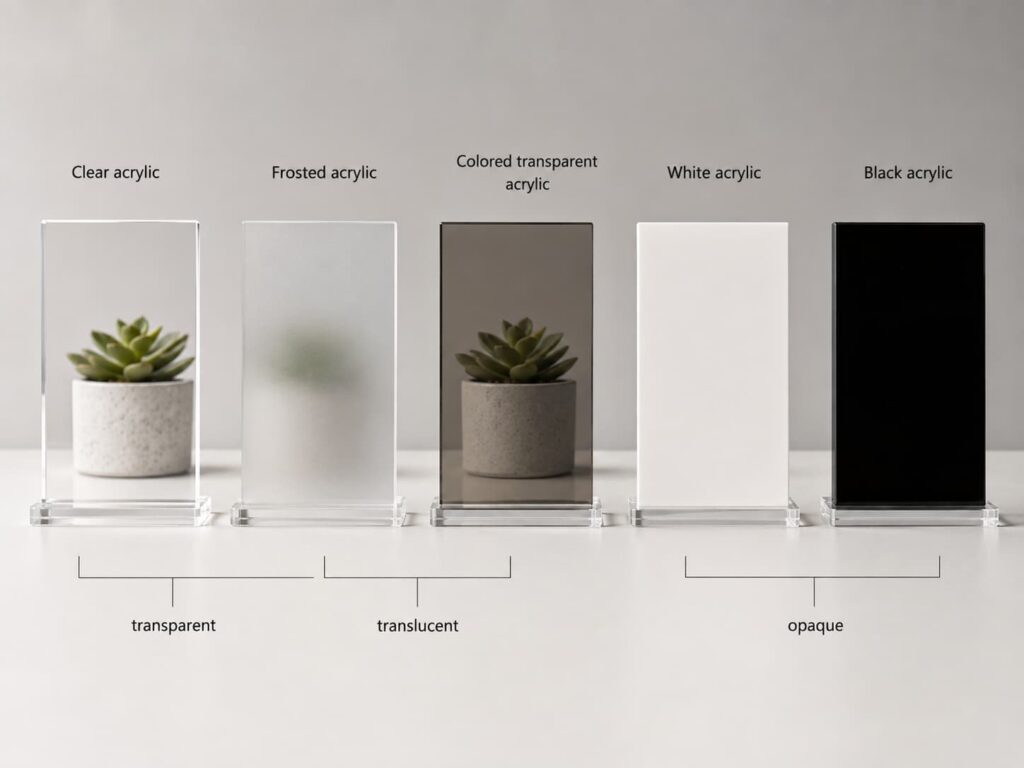
For example, “white acrylic” could mean a translucent white diffuser or an opaque white panel. The application and lighting requirement must complete the specification.
Application Selection Matrix
| Application | Starting category | Main selection question |
|---|---|---|
| Retail product cover | Transparent | How clear must the view be, and are the edges exposed? |
| Illuminated sign face | Translucent | Will the sheet diffuse the selected LEDs and reproduce the intended color? |
| Privacy partition | Translucent or opaque | Should the panel retain daylight or fully block visibility? |
| Brand backdrop | Opaque | What color, gloss, printing, and edge finish are required? |
| Machine guard | Transparent | What visibility, mounting, machining, and project safety requirements apply? |
| Display base or housing | Opaque | How will the part be cut, bonded, assembled, and packed? |
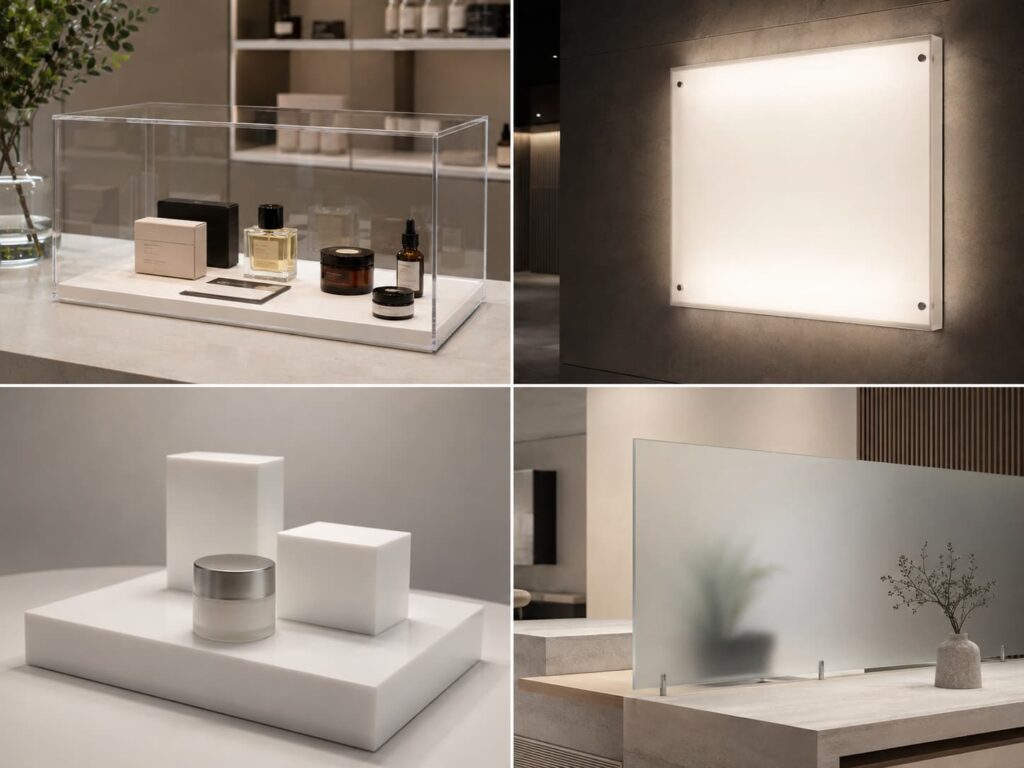
Comparing More Than One Material Option?
Share your display concept, required visibility, lighting method, dimensions, and reference image. Grandview Acrylic can help review suitable optical categories before the design is released for production.
Validate Thickness, Color, and Lighting Together
Two sheets in the same optical category can look different in the finished project. Thickness affects rigidity, weight, edge appearance, color depth, and—in many translucent colors—the amount of transmitted light. The perceived color also changes with the light source and the balance of transmitted and reflected light.[2]

For lighting projects, transmission and diffusion are separate goals. Specialty light-diffusing acrylic may use particles within the material to spread light and reduce hot spots, but the balance varies by grade and lighting system.[3]
Important Note
These categories are starting points, not fixed rules. Exact results depend on grade, color, thickness, surface, lighting, fabrication, mounting, and installation conditions.
Fabrication Considerations Before Material Approval
Material and fabrication should be reviewed together. Cutting, machining, forming, and finishing conditions can influence edge quality and internal stress.[6]
Appearance-Critical Details
- Transparent: clarity, exposed edges, polishing, masking, and scratch control.
- Translucent: illuminated edges, light leaks, visible joints, graphics, and hardware concealment.
- Opaque: face and edge color, gloss, printing, and cleaning.
Processing Route
- Laser cutting: profiles and display parts; confirm edge expectations.
- CNC machining: holes, slots, pockets, thicker parts, and controlled geometry.
- Bending and bonding: review bend lines, joints, and appearance-critical surfaces before production.
Related guides: acrylic sheets for laser cutting, custom acrylic CNC service, and cast vs extruded acrylic sheets.
Common Buyer Mistakes
- 01Treating “frosted” and “translucent” as identical
Specify both the finish and the required transmission, diffusion, or privacy effect.
- 02Approving color from a screen image
Use a physical sample when color, lighting, or repeat-order consistency matters.
- 03Ignoring the final light source
Test translucent material with the intended LEDs, graphics, cabinet, and ambient light.
- 04Choosing thickness before reviewing the design
Coordinate thickness with dimensions, support, mounting, cutting, bending, and assembly.
- 05Finalizing drawings before confirming the material route
Edge finish, printing, bend lines, and joints may require drawing changes.
What to Prepare Before Requesting a Quote
Application
Display, lightbox, partition, guard, housing, or OEM component
Optical requirement
Clear visibility, diffused light, privacy, or visual blocking
Appearance
Color, gloss, matte or frosted finish, and critical surfaces
Dimensions
Thickness, size, geometry, exposed edges, and mounting details
Lighting
Non-illuminated, front-lit, backlit, or edge-lit conditions
Fabrication
Laser, CNC, drilling, polishing, printing, bending, bonding, or assembly
Production
Quantity, sample approval, tolerances, and repeat-order needs
Delivery
Whole sheets, cut parts, finished components, packaging, and destination
PROJECT MATERIAL REVIEW
Turn a Visual Idea into a Clear Acrylic Specification
Send your drawing, dimensions, color, thickness, lighting condition, fabrication requirements, quantity, and destination. Grandview Acrylic can review a suitable material and processing route for your project.
FAQ
Are clear acrylic and transparent acrylic the same?
Clear acrylic is generally a colorless transparent acrylic. Transparent acrylic may also be tinted while still allowing objects behind it to remain visible.
Is frosted acrylic always translucent?
Frosted usually describes a finish. The actual transmission, diffusion, and privacy level depend on grade, color, thickness, and surface treatment.
Which acrylic is commonly considered for a lightbox?
Translucent acrylic is often considered, but it should be reviewed with the intended LEDs, graphics, panel thickness, cabinet, and sample approval process.
Does thickness affect translucent acrylic?
It can affect rigidity, color depth, edge appearance, and light transmission. Confirm the intended thickness during sample review.
What should I send for a custom quote?
Provide the application, optical effect, color, finish, thickness, dimensions, drawings, lighting, fabrication, quantity, packaging, and destination.
Conclusion
- Transparent acrylic supports clear visibility.
- Translucent acrylic transmits and diffuses light while softening detail.
- Opaque acrylic creates a solid surface and conceals what is behind it.
For B2B projects, the category name is only the beginning. Color, thickness, finish, lighting, cutting, printing, bending, bonding, assembly, and sample approval all influence the finished result. Grandview Acrylic supports international buyers with sheet supply and custom fabrication for displays, lighting, signage, fixtures, protective parts, and OEM projects.
References and Further Reading
These neutral and manufacturer-authored technical sources support the optical terminology, testing context, and fabrication guidance in this article.
- PLEXIGLAS® — Light Transmission
Transparent and translucent terminology, transmittance, and thickness context. View source
- ACRYLITE® — Light Transmission for White and Colored Acrylic Sheet
Color, pigments, thickness, diffusion, lamp hiding, and evaluation under end-use lighting. View source
- ACRYLITE® Satinice — Optimum Light Diffusion
Light diffusion, transmission balance, and hot-spot reduction. View source
- ASTM International — ASTM D1003
Test method for haze and luminous transmittance of transparent plastics. View source
- ASTM International — ASTM D4802-16(2024)
General PMMA acrylic sheet specification, classifications, finishes, and optical properties. View source
- PLASKOLITE — OPTIX® Acrylic Sheet Fabrication & Machining
Cutting, machining, forming, finishing, and stress-related fabrication guidance. View source
Project note: Acrylic appearance and performance vary by grade, color, thickness, finish, lighting, fabrication, mounting, and end-use environment. Confirm supplier data, samples, drawings, and project-specific requirements before mass production.