Acrylic optics · UV behavior
Partly — and “how much” is the wrong first question
Standard clear acrylic stops UV-C and most UV-B. It starts letting light through at around 375–380 nm, close to where visible light begins, so part of the UV-A band passes along with all the visible light that makes acrylic look clear.
Whether that is enough depends on what the sheet is there to protect. It might be the sheet itself, which has to survive sunlight. It might be whatever sits behind it, which may fade. Or it might be a process on the other side that actually needs the UV to reach it. These are three different requirements, and most of the confusion about acrylic and UV comes from treating them as one.
UV resistant protects the sheet.
UV filtering protects the contents.
UV transmitting protects the job.
Where standard acrylic stops UV
UV light is usually split into three bands: UV-C from about 100–280 nm, UV-B from 280–320 nm and UV-A from 320–400 nm. Some sources put the UV-A/UV-B boundary at 315 nm instead [5]. Shorter wavelengths carry more energy and do more damage.
Acrylic does not block UV like a switch. Transmission sits close to zero at short wavelengths and then rises over a fairly narrow range. The Health Physics Society notes that most acrylics transmit light above about 375 nm but do not pass UV-C, even in sheets thinner than 5 mm, which is why standard acrylic will not work as a window for a germicidal UV-C lamp [1]. A supplier of optical-grade PMMA describes the same edge from the other side: standard acrylic contains UV inhibitors that block most wavelengths below roughly 380 nm [3].
What does that mean for daylight? Sunlight at ground level contains almost no UV-C [1]. A sheet that is excellent at stopping UV-C still lets through a real share of the UV that does arrive, which is mostly at the long end. ACRYLITE puts it plainly: general-purpose acrylic and ordinary float glass filter out only a small amount of the UV in solar radiation [2].
Why “blocks 93%” and “blocks 60%” can both appear online
Search this question and you will find the same plain clear sheet described as blocking 93%, 80–90% or 60–70% of UV. These figures are not necessarily invented. They answer different questions.
A percentage needs a denominator, and the sources rarely state theirs. Some average across 280–400 nm. Others weight the result by how much energy sunlight carries at each wavelength. Some quote a single wavelength. Thickness and formulation differ too. A sheet that blocks nearly all UV-C and UV-B can honestly be said to block “most UV” and also be said to pass a meaningful part of solar UV.
Three jobs that all get called “UV protection”
Once you know the cut-off sits around 375–380 nm, the real question is what you need from the sheet. Suppliers do not use the labels consistently, so describe the job rather than relying on a product name.
| What you need | What is at risk | What to specify | Typical situations |
|---|---|---|---|
| Protect the sheet | The acrylic yellows, hazes or turns brittle | Weathering performance of the grade | Outdoor covers, exterior panels, sun-facing glazing |
| Protect what sits behind it | Prints, dyes, fabrics or products fade | A UV cut-off pushed closer to visible light | Display cases, window displays, framed work, archive covers |
| Let UV through | The process behind the sheet stops working | Transmission down to the wavelength the process uses | UV curing and inspection windows, UV lamp covers, UVB-lit animal enclosures |
Protecting the sheet
Clear acrylic is widely used outdoors because PMMA itself is stable under UV. Röhm describes this as a property of the whole sheet rather than a surface layer, and backs its clear PLEXIGLAS sheet with a long anti-yellowing warranty [4]. Resistance still varies by grade and producer, so outdoor projects should check the data for the specific sheet. Our guide to UV resistant acrylic sheets for outdoor and window-facing projects covers that selection.
Weathering resistance says nothing about what passes through the sheet. A panel can stay perfectly clear for years while still letting long-wave UV-A reach whatever is behind it.
Protecting what sits behind it
UV-filtering acrylic moves the cut-off further toward visible light. That matters because the damage done by light rises sharply as the wavelength gets shorter. ACRYLITE gives a “probable relative damage” factor of about 8 at 300 nm, 1 at 380 nm and 0.03 for green light at 500 nm [2]. Removing the last band of UV therefore removes a large share of the fading risk, even though it is a small slice of the light.

This is not only an outdoor problem. Halogen lamps emit a considerable amount of UV and fluorescent lamps emit some [2]. A display case under halogen spotlights, or one standing next to a shop window, can need UV filtering even though it never sees direct sun. If you are unsure about a light source, the lamp’s spectral data will tell you more than its name.
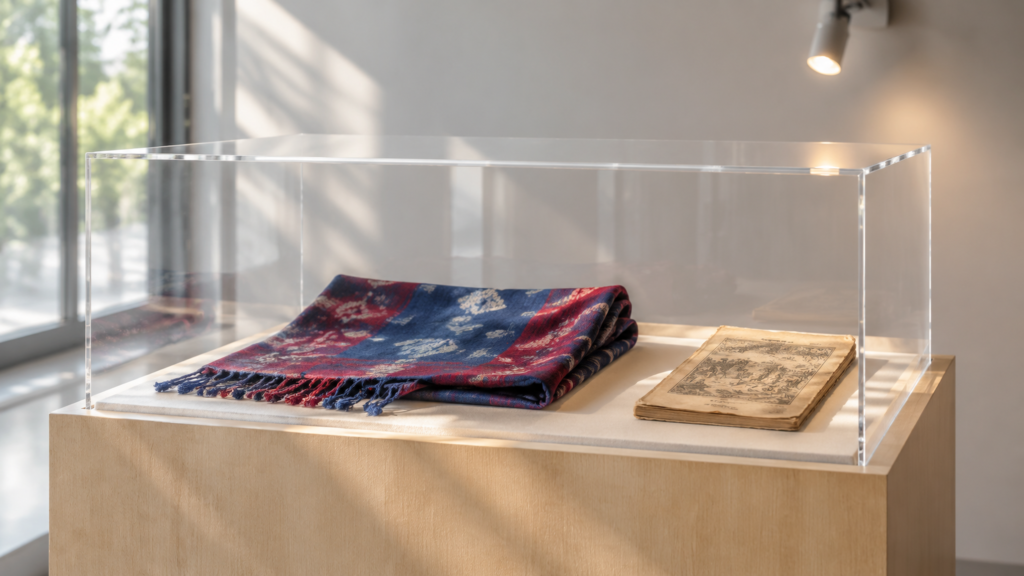
Filtering has two limits. First, it slows fading but does not stop it, because visible light also causes damage, only at a much lower rate. Second, there is a reason the cut-off is not pushed further. Once the sheet starts absorbing blue visible light, the objects behind it begin to look yellowish [2]. For bright whites and accurate brand colors, the highest filtering level is not automatically the best choice.
For short-lived, low-value or replaceable contents under low-UV lighting, standard clear sheet is often enough. Specifying a filtering grade there adds cost without solving a problem.
Letting UV through
Some jobs need the opposite. UV curing stations, UV inspection systems, sterilization equipment and animal enclosures lit by UVB lamps all depend on UV reaching the other side. Standard acrylic gets in the way because of the very inhibitors that make it useful elsewhere.
UV-transmitting (UVT) acrylic leaves those inhibitors out. One optical-grade cast example transmits from 260 nm and passes about 80% at 300 nm [3]. The same supplier is open about the trade-off: without inhibitors, the sheet itself yellows under prolonged high-intensity UV and its transmission changes over time. A scratch-resistant hard coat that contains UV inhibitors will also reduce UV transmission.
Does cutting, polishing or bending change UV performance?
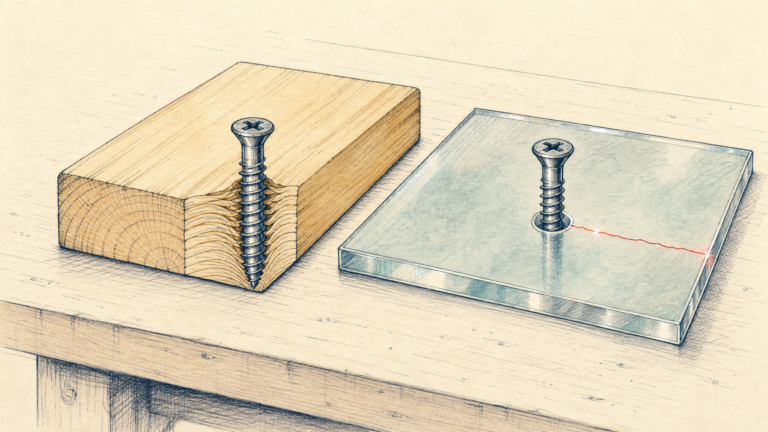
It depends on where the UV protection lives. When the UV absorber is mixed through the whole sheet, cutting, routing and edge polishing do not remove it. The new edge has the same chemistry as the face.
When the UV function comes from a coating, anything that removes or stresses the surface can affect it: sanding or buffing out scratches, tight bends and some solvents. Röhm notes that thin surface treatments may scratch, chip or crack [4]. Specialty grades may also carry their own forming and bonding guidance. So before a UV-filtering or UVT sheet is machined, bent or bonded, ask whether the protection runs through the sheet or sits in a coating, and check the fabrication steps against that answer.
How to check a sheet’s UV behavior
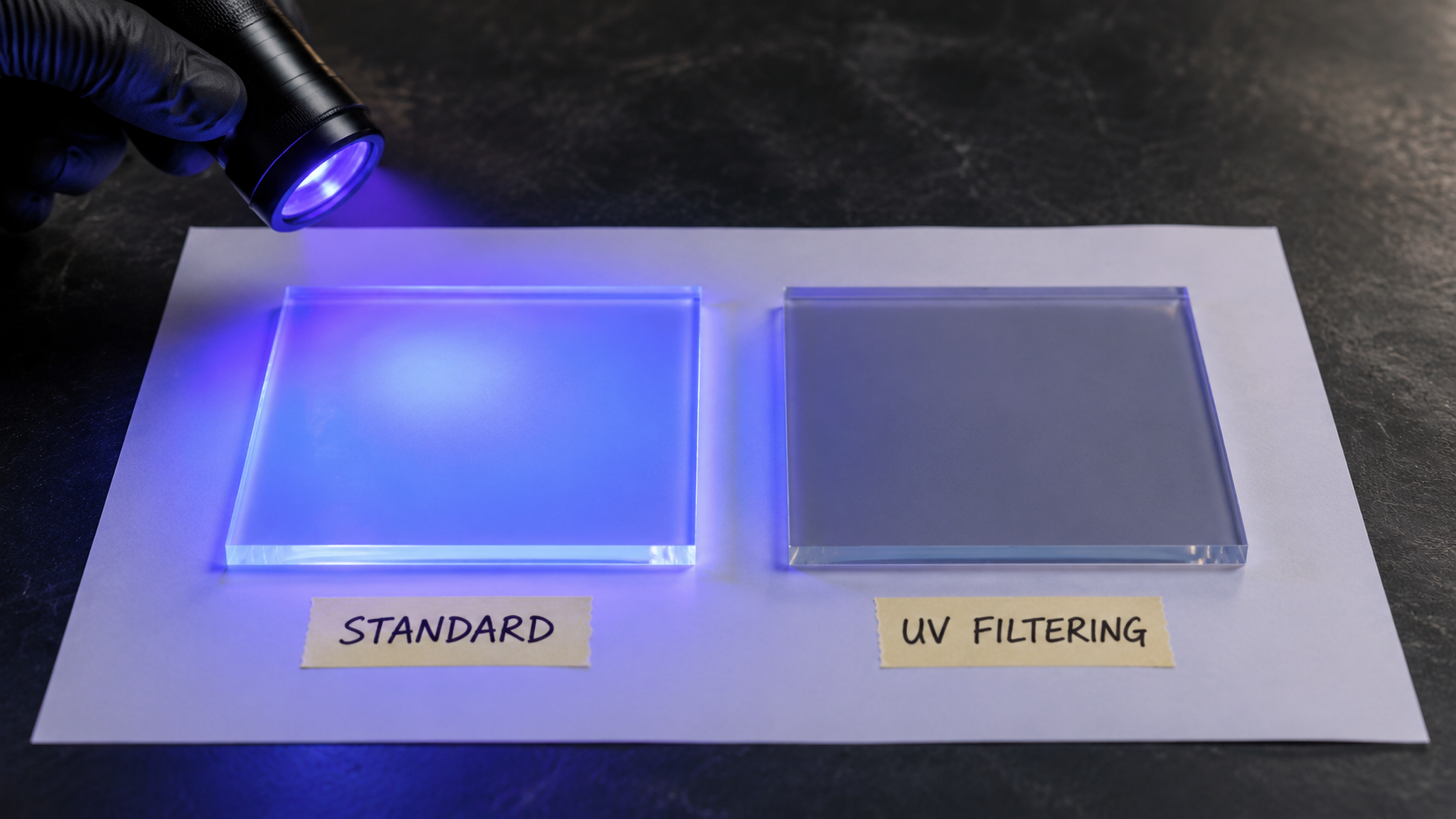
A UV torch shows you that a sheet blocks UV. It cannot show you how much.
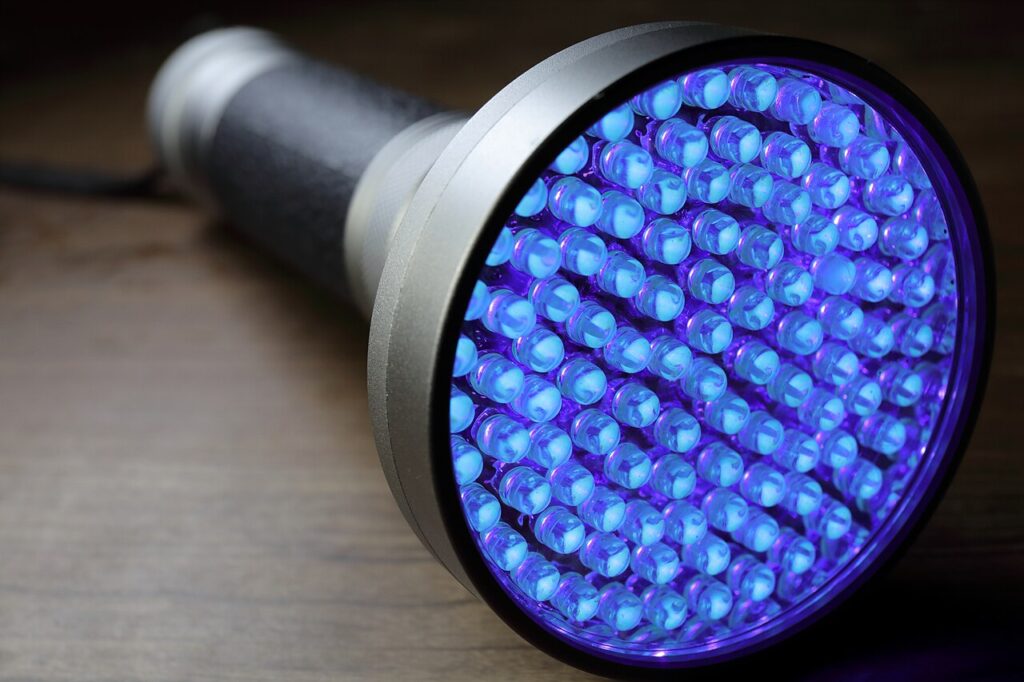
The quick check is simple. Darken the room, place a sheet of plain white paper on a table and lay two sheets side by side on it: one known standard clear sheet and the sheet you want to test. Shine the torch through each. A UV-filtering sheet makes the glow on the paper noticeably darker than the standard sheet does.
The comparison sheet matters. A 365 nm torch sits close to the cut-off of ordinary acrylic, so even standard sheet may dim it somewhat; judged on its own, a sample can look more protective than it is. The test also gives no number. It cannot tell a modest filter from a conservation-level one. For a real answer you need documents, and each answers a different question:
| Document | What it tells you | What it does not tell you |
|---|---|---|
| UV transmission curve | How much light passes at each wavelength, including the cut-off | How the sheet will age |
| Weathering or light-ageing result | How the sheet itself changed after a defined exposure | How much UV the sheet passes |
| Visible light transmittance | How clear the sheet looks | Anything about UV |
The datasheet for our clear cast acrylic sheets shows the difference. It lists 92.5% total luminous transmittance, a visible-light figure, and a light-ageing result under ISO 4892-3, which describes how the sheet’s color held up under exposure rather than what passes through it. Weathering standards such as ISO 4892 and ASTM D4329 define how a sample is exposed; they do not set a pass mark, so the result depends on the criteria the producer or buyer applies [5].
When a project depends on UV behavior, write these into the requirement
- The job: protect the sheet, protect the contents, or let UV through
- The light source: direct sun, sun through window glass, halogen, fluorescent, or a UV lamp with its wavelength
- The range: target cut-off or transmission in nanometers, not just a percentage
- Where the protection lives: whether a coating is acceptable or it must run through the sheet
- What happens next: any cutting, polishing, bending or bonding after supply
FAQ
Does Plexiglas block UV the same way as acrylic?
Plexiglas is a brand name for acrylic (PMMA), so the answer is the same: it depends on the grade. Standard clear Plexiglas behaves like other standard acrylic; UV-filtering and UV-transmitting versions are separate products.
Does thicker acrylic block more UV?
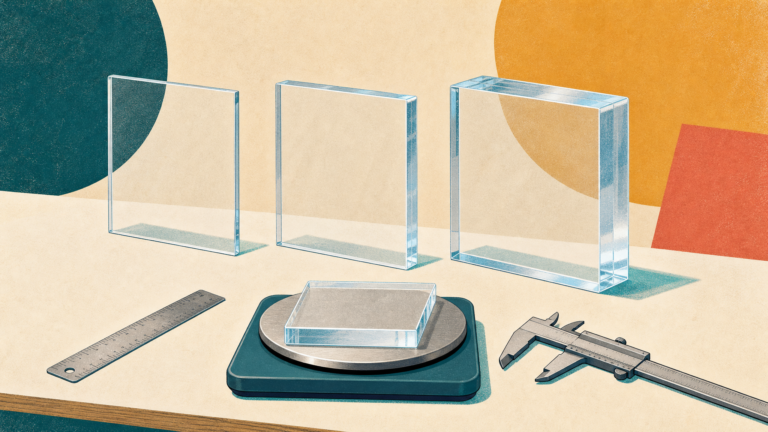
Thickness has some effect, but it does not turn standard sheet into a UV-filtering sheet, and a thin standard sheet still does not pass UV-C [1]. If the exact figure matters, ask for the transmission curve at the thickness you plan to use.
The short version
Acrylic is very transparent to visible light and largely opaque to short-wave UV. That combination is why it works for clear outdoor parts, why it is often not enough on its own for light-sensitive contents, and why UV-dependent equipment needs a special grade. Before asking how much UV a sheet blocks, decide what it is protecting.
Not sure which of the three jobs your part has to do? Send us a short description of the application and the light it will sit under. We can help you work out whether standard clear acrylic is enough before you specify anything more.
References and further reading
- Does Acrylic Plastic Prevent Ultraviolet-C (UV-C) Radiation? Health Physics Society, Ask the Experts (2017). Supports: acrylic transmits above about 375 nm and does not pass UV-C, even below 5 mm; little UV-C in ground-level sunlight. View source
- Why should I use UV filtering (OP3) acrylic sheet? ACRYLITE Knowledge Base. Supports: filtering-grade cut-off at 390 nm, ~98% UV absorbed, relative damage factors, halogen and fluorescent UV, yellowish cast if pushed further. View source
- UV-Transmission Acrylic Filters (UVT, S-0). Astra Products. Supports: standard acrylic inhibitors below ~380 nm; UVT transmission from 260 nm and ~80% at 300 nm; UVT ageing and hard-coat limits. View source
- Natural UV protection: No visible yellowing in almost all clear-transparent PLEXIGLAS products. Röhm. Supports: whole-sheet UV stability versus thin surface treatments. View source
- UV Properties of Plastics: Transmission and Resistance. Cole-Parmer, with Zeus Industrial Products. Supports: UV band definitions; ISO 4892 and ASTM D4329 exposure methods without pass marks. View source