MATERIAL SELECTION FOR FABRICATED PARTS
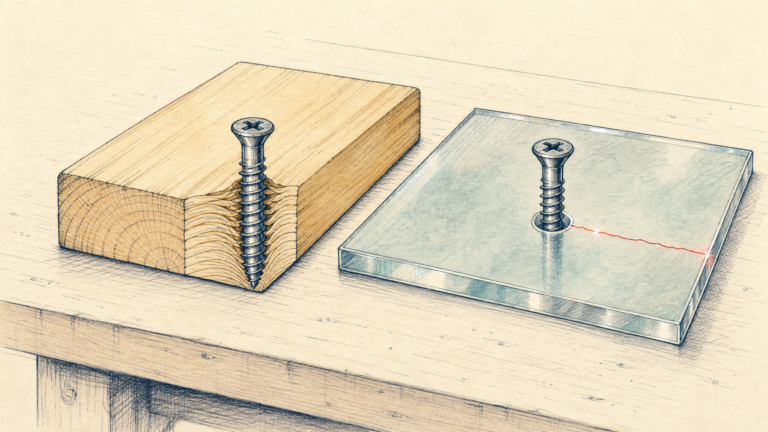
Two clear sheets can take very different routes to an accepted part.
The useful comparison begins after cutting, drilling, forming, bonding, cleaning, installation, and handling—not while two untouched samples are lying on a table.
Choose the finished part first. The sheet follows.
Two clear sheets can look almost interchangeable on a sample table. They stop looking interchangeable after the part is cut, drilled, bent, bonded, cleaned, installed, and handled.
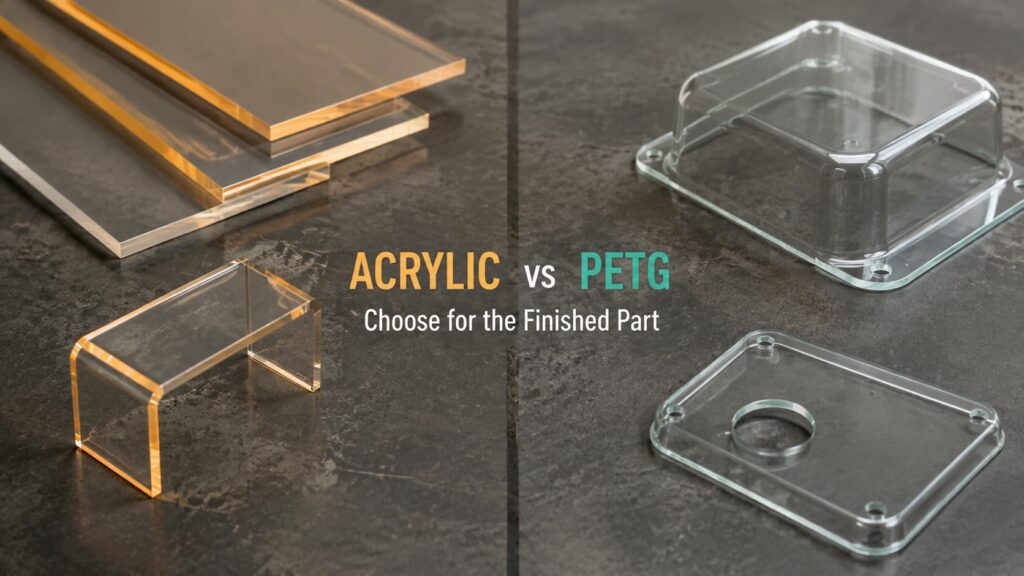
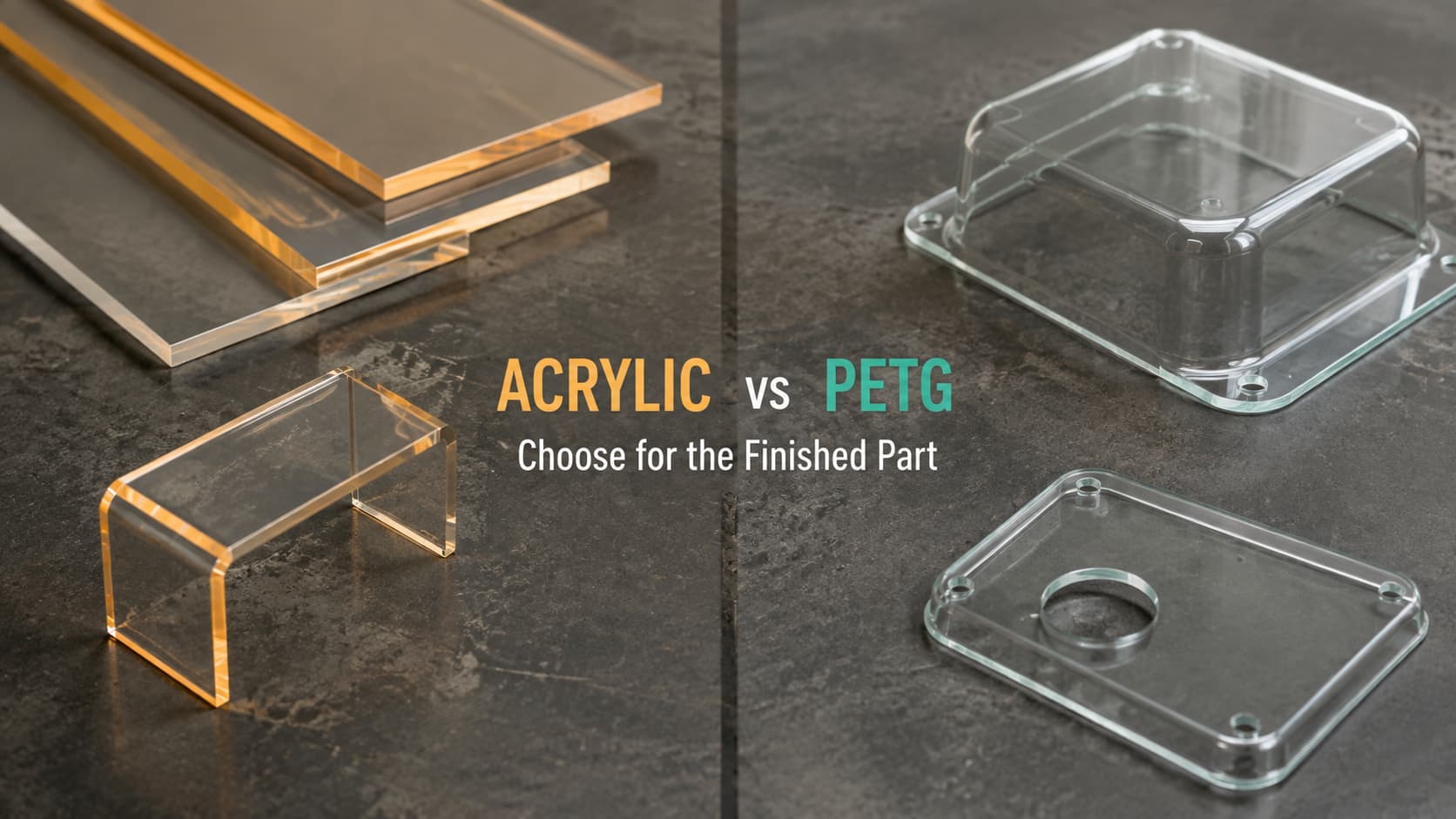
Acrylic (PMMA) is often the stronger starting point for a flat, customer-facing part where optical appearance, rigidity, exposed edges, or outdoor performance matter. PETG is often the stronger starting point for a deeply formed, frequently handled, or impact-prone part. Neither rule is absolute: grade, thickness, geometry, fabrication sequence, and service conditions can change the result.
The useful question is not “Which plastic is better?” It is “Which material is more likely to produce the finished part we can approve?”
Acrylic vs PETG: The Short Answer
START WITH ACRYLIC WHEN
Finish and rigidity lead the decision.
- Flat or lightly bent geometry
- Customer-facing surface
- Exposed or polished-looking edges
- Outdoor exposure to be specified
START WITH PETG WHEN
Forming and handling lead the decision.
- Deep or complex formed geometry
- Repeated handling
- Bumps and accidental impact
- Brittle fracture is a key concern
A clear flat swatch cannot tell you how a drilled hole, formed corner, polished edge, bonded joint, or cleaned surface will perform. The starting rule narrows the candidates; it does not replace grade review and sample approval.
Choose by Finish, Form, and Field
Most acrylic-versus-PETG comparisons begin with a list of properties. That is useful, but it puts the decision in the wrong order. A fabrication project becomes clearer when both candidate materials pass through the same three project gates.
Finish: What must the customer see?
Consider the front face, exposed edges, joints, printed areas, and any surface viewed under direct or back lighting. Acrylic is commonly favored for high-clarity, customer-facing components and bright-looking cut or polished edges. PMMA also generally offers a harder surface, which can help where fine scratches are easy to see.[3]
PETG remains a clear material, but its tougher behavior comes with a softer, more easily marked surface. Masking, handling, cleaning, and packaging may therefore carry more weight in the specification.
Form: What must happen to the sheet?
A flat laser-cut panel and a deep-drawn cover should not begin with the same material assumption. PETG is often more forgiving for complex thermoformed shapes and impact-prone formed parts. Acrylic can also be bent and thermoformed; the real distinction is how readily the selected grade produces the required geometry and finish within a workable process window.[5][6]
Field: What happens after the part leaves the workshop?
Will it be installed indoors or outdoors? How often will it be touched or cleaned? Which cleaner will be used? Is there impact risk, mechanical load, elevated temperature, or constant UV exposure?
Acrylic has a long-established role in outdoor transparent applications. PETG should not be treated as one universal outdoor material: standard indoor grades and UV-protected grades are different products. Outdoor suitability must be checked against the selected grade, supplier documentation, expected exposure, and warranty terms.[2] The guide to UV-resistant acrylic sheets covers the acrylic side of this decision in more detail.
Chemical resistance also needs a specific question. “Cleaning chemicals” is not a test condition. Identify the substance, concentration, contact time, temperature, and whether the part will be under stress.
Where the Fabrication Process Changes the Choice
“Easy to fabricate” is too broad to approve a material. The relevant question is what each operation does to the edge, surface, geometry, residual stress, joint, and later assembly.
| Fabrication Step | Why Acrylic May Lead | Why PETG May Lead | What Must Be Verified |
|---|---|---|---|
| Laser cutting and engraving | Often selected for fine detail and a bright-looking edge | Cutting behavior and edge quality depend on grade and equipment | Melt, discoloration, heat stress, later bonding, and solvent contact |
| CNC, sawing, and drilling | Rigidity can support accurate parts; tooling must control chipping or cracking | Toughness reduces brittle failure, but flexibility, heat, and burrs can affect results | Tooling, clamping, holes, edge quality, and assembly load |
| Line bending | Suitable when the grade and bend design are appropriate | Often more forgiving where handling toughness matters | Radius, stress, spring-back, whitening, and cooled appearance |
| Deep thermoforming | Viable when acrylic appearance and rigidity are required | Frequently the first material to evaluate for deep or complex forms | Draw depth, wall distribution, shrinkage, trimming, and consistency |
| Visible-edge finishing | Usually the stronger starting point when the edge is part of the design | Needs a grade-appropriate method and realistic edge standard | The actual edge at the specified thickness |
| Bonding, printing, and assembly | Broadly fabricable, but residual stress can affect later solvent contact | Adhesive, ink, and joint appearance need grade-specific confirmation | Process order, preparation, visible joints, and compatibility |
An attractive laser-cut edge is not proof that the part is ready for service. Laser heat can leave stress near an acrylic edge; later solvent contact or mechanical load may reveal a problem.[4] Likewise, successful PETG forming does not automatically confirm surface durability, printing, or assembly.
If cutting is the critical process, the guide to acrylic sheets for laser cutting explains the acrylic edge and material variables in more detail. Thickness, span, supports, and hole layout should be reviewed separately using the acrylic sheet thickness guide.
Application Selection Matrix
The following recommendations are starting points, not universal winners. Each row begins with the feature most likely to control acceptance.
| Part or Application | Starting Point | Why | Do Not Approve Before Checking |
|---|---|---|---|
| Premium retail or cosmetic riser with exposed edges | Acrylic | Face and edge appearance are acceptance-critical | Cut edge, polish, joint, lighting, and scratch standard |
| Flat transparent cover or interior panel | Acrylic | Clarity and rigidity may matter more than deep-forming behavior | Thickness, span, supports, holes, cleaning, and packing |
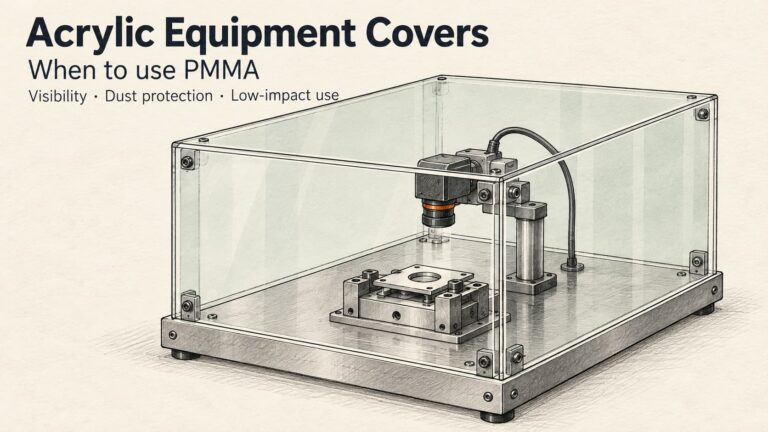
| Deep-formed equipment cover or housing | PETG | Formability and toughness often carry more weight | Corners, wall distribution, trimming, heat, and impact requirement |
| Frequently handled protective cover | PETG | Resistance to bumps and brittle breakage may be decisive | Surface marking, cleaner, stiffness, fastening, and grade |
| Outdoor transparent panel or sign component | Acrylic or documented UV-grade alternative | Outdoor performance must be tied to the exact grade | UV specification, exposure, thickness, fixing, and warranty terms |
| Printed and bent indoor component | Depends | Acrylic may favor finish; PETG may favor forming and handling | Print adhesion, bend, edges, cleaning, and assembly sequence |
Common Selection Failures—and What They Reveal
Failure symptoms are useful only when they are connected to the geometry, process sequence, and service condition that produced them.
The flat swatch passed, but the part failed.
Transparency was approved; the hole, bend, joint, mounting load, and cleaning routine were not.
The part cracked or crazed after fabrication.
Geometry, drilling or laser stress, a tight fastener, solvent contact, or process order may be responsible—not simply “bad acrylic.”
The surface marked, softened, or missed the edge standard.
Impact and forming were prioritized without defining handling, heat, finishing, cleaning, or packaging.
The panel flexed too much—or failed around its fixings.
Material choice was separated from thickness, span, hole location, mounting, and load.
These failures point to the same lesson: a polymer name is only the beginning of a specification.
Approve a Processed Sample, Not Only a Flat Swatch
For a fabrication project, the most useful sample includes the operation most likely to change the result.
-
01
Define the acceptance-critical feature
The face, edge, bend, formed corner, hole, joint, or printed area.
-
02
Produce the proposed grade and thickness
Include the intended process sequence where practical.
-
03
Review under realistic conditions
Use the relevant lighting, handling, assembly, cleaner, support, and viewing distance.
-
04
Record and approve the result
Use it as the production reference; review again if grade, thickness, geometry, or critical process changes.
Approve the material after the critical process—not before it.
Compare Accepted-Part Cost, Not Only Sheet Price
There is no reliable universal answer to whether acrylic or PETG is cheaper. Published comparisons disagree because sheet price changes with grade, thickness, volume, region, and supplier. More importantly, sheet price is only one part of the cost.
- 01Material utilization, tooling, setup, and cycle time
- 02Scrap, rework, inspection, and edge finishing
- 03Masking, handling, and packaging
- 04Bonding, printing, assembly, and failures found after installation or cleaning
A material that costs less per sheet can cost more after extra finishing or rejected parts. A material that forms easily can still lose its advantage if the finished surface cannot meet the visual standard.
What to Prepare Before Requesting a Material or Fabrication Review
A useful inquiry describes the part, not just the plastic.
FINISHED-PART BRIEF
Send the conditions that “clear sheet” cannot describe.
- PartApplication and flat, bent, or deeply formed geometry
- DrawingDimensions, holes, bends, joints, and supports
- MaterialProposed grade and thickness, if already specified
- ProcessCritical operations and acceptance-critical faces, edges, or dimensions
- FieldIndoor or outdoor conditions, lighting, impact, heat, and actual cleaners
- OrderPrototype and production quantities, packaging, and destination
The review should confirm what needs to be sampled; it should not force acrylic into a part better served by another material. For drawing-based acrylic cutting and machining, see the laser cutting and CNC machining service.
Acrylic vs PETG FAQs
Is PETG always more impact-resistant than acrylic?
PETG is generally tougher and less prone to brittle fracture than standard acrylic, but there is no universal multiplier. Results vary with grade, thickness, specimen, and test method. Compare the exact candidate sheets, then check the real geometry and mounting.
Which is better for laser-cut visible edges?
Acrylic is usually the first material to evaluate when a bright-looking laser edge is part of the design. Sheet, thickness, laser setup, and later operations still matter. Check for heat-affected stress if the part will be bonded, solvent-cleaned, or loaded.
Can PETG be used outdoors?
Yes, when the product is designed and documented for the intended exposure. Standard indoor PETG and UV-protected grades are not interchangeable. Confirm the technical data and warranty conditions.
Is PETG always easier to thermoform than acrylic?
PETG is often more forgiving for deep or complex forms. Acrylic is also thermoformable and may be preferred when appearance, rigidity, or outdoor performance carries more weight. Geometry, tooling, heating, wall distribution, and trimming decide the result.
Which material is better for frequent cleaning?
There is no honest winner without naming the cleaner and service conditions. Check the grade against the chemical, concentration, temperature, contact time, and stress state. Test a fabricated sample rather than an unstressed offcut.
Conclusion: Specify the Accepted Part, Then Select the Sheet
Acrylic is often the better starting point for a rigid, highly visible, edge-sensitive, or outdoor part. PETG is often the better starting point for a deeply formed, frequently handled, or impact-prone part. The final choice still belongs to the specified grade, thickness, geometry, process sequence, and service environment.
Do not approve a flat sheet for a job that will be judged as a fabricated component. Define the accepted part, produce its critical feature, and approve the result after processing.
FROM MATERIAL CANDIDATE TO ACCEPTED PART
Choose the finished part first. The sheet follows.
For an acrylic project, send the drawing, critical process, visible-edge or surface requirement, quantity, packaging needs, and destination for a fabrication-focused review.
Request an Acrylic Part ReviewTECHNICAL SOURCES
References and Further Reading
- [1]VIVAK PETG and OPTIX Acrylic Product Information
Source: PLASKOLITE. Provides grade-specific property and application context for named PETG and acrylic sheet products; figures should not be generalized to every sheet.
- [2]PETG Product Range
Source: PLASKOLITE. Supports the distinction between standard indoor PETG and UV-protected PETG grades.
View Source - [3]Scratch Resistance of PLEXIGLAS®
Source: PLEXIGLAS® / POLYVANTIS. Supports the general surface-hardness context for PMMA and the need to distinguish standard and coated grades.
View Source - [4]Laser Machining ACRYLITE® Acrylic Sheet
Source: ACRYLITE®. Supports the relationship between laser-cut appearance, heat input, residual edge stress, and later solvent or mechanical exposure.
View Source - [5]Thermoforming ACRYLITE® Acrylic Sheet
Source: ACRYLITE®. Provides acrylic-specific context for thermoforming, heating, shrinkage, forming geometry, cooling, and material-grade differences.
View Source - [6]Eastman Spectar™ 14471 Copolyester Technical Data Sheet
Source: Eastman. Provides grade-specific PETG/copolyester data and reinforces that final performance depends on material, design, tooling, and process conditions.
View Source
Optical, impact, UV, thermal, chemical, food-contact, and fabrication performance remain grade-, supplier-, test-, geometry-, and project-specific. Confirm the candidate data sheets and a representative processed sample before production.