PMMA NAMES + PROCUREMENT TRANSLATION
Four familiar names.
One material family.
More than one specification.
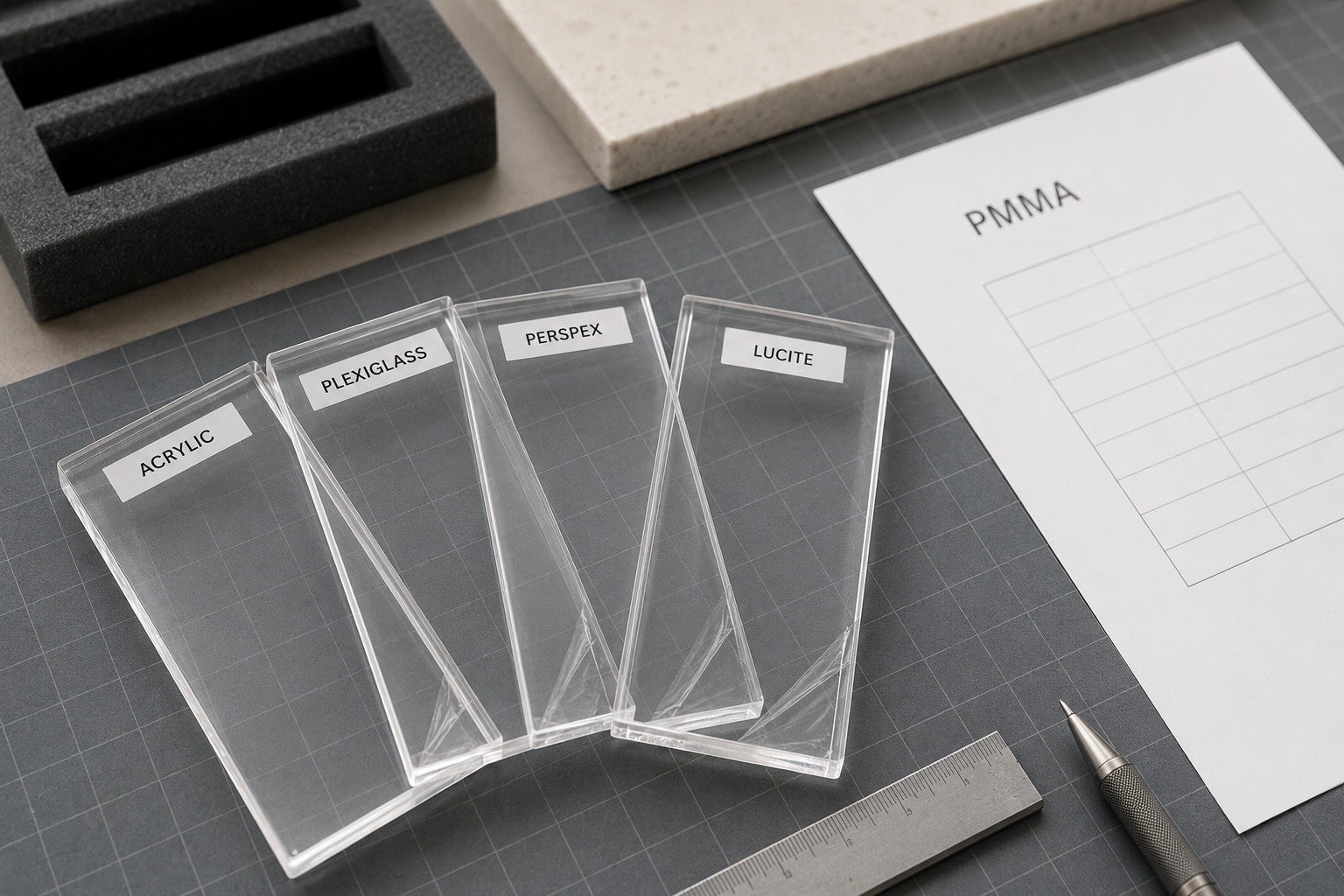
Acrylic, plexiglass, Perspex, and Lucite often point buyers toward PMMA. The name starts the conversation—but it does not finish the material specification.
A product name is not a complete purchase specification.
Same family does not mean same specification.
In everyday sheet-market language, these names usually refer to PMMA, the transparent thermoplastic commonly sold as acrylic sheet. In a quotation, drawing, or production order, however, the names are not technically interchangeable.
A name tells you which material family to investigate.
A data sheet tells you what you are actually buying.
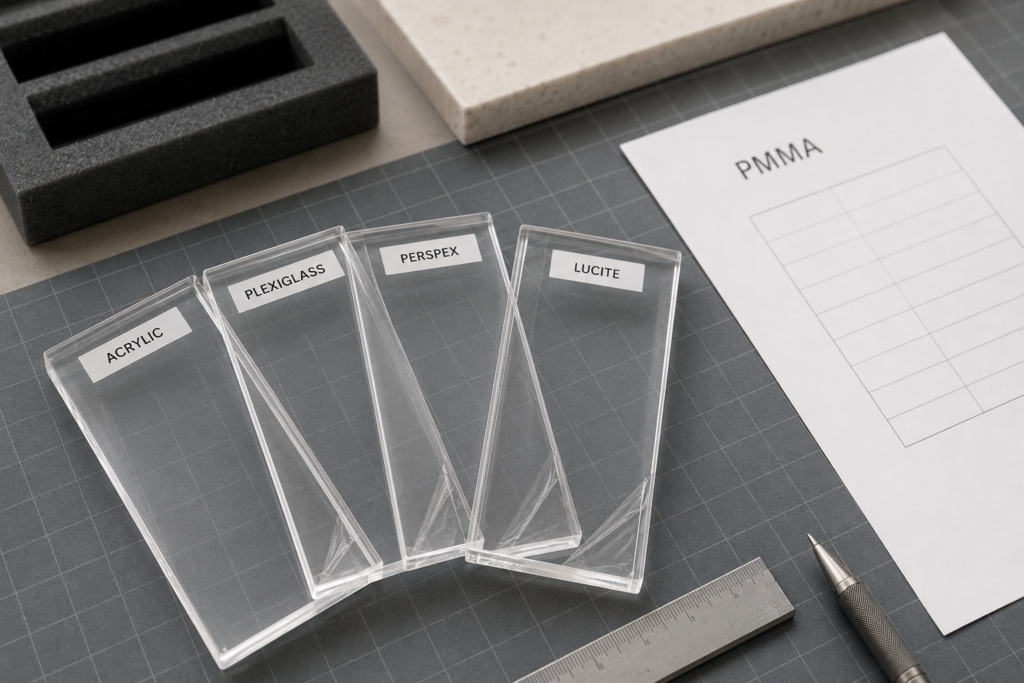
A buyer asks for acrylic. A drawing specifies Perspex. Another RFQ requests Plexiglass, while a designer describes the same clear component as Lucite.
They may all be trying to source PMMA—but that does not prove they need the same brand, manufacturing process, grade, color, tolerance, or finished-part performance. Casual language is useful during early discussion. It becomes risky when nobody translates it into a production requirement.
At first glance, acrylic vs Plexiglass seems like a material comparison. In most commercial conversations, both names point to PMMA; Perspex and Lucite are also associated with the same material family.
| Term | What it usually means | What the name does not confirm |
|---|---|---|
| Acrylic sheet | The generic sheet-industry term commonly used for PMMA. | Brand, manufacturing process, grade, or performance. |
| plexiglass | A widely used informal name for acrylic sheet. | Genuine PLEXIGLAS® origin or a particular sheet type. |
| PLEXIGLAS® | A registered PMMA brand associated with Röhm. | That every product is cast rather than extruded. |
| PERSPEX® | A branded acrylic sheet range currently marketed by 3A Composites. | That every sheet casually called “perspex” is genuine PERSPEX®. |
| Lucite® | A trade name used for PMMA and acrylic resin products associated with Mitsubishi Chemical. | A specific sheet process, tolerance, or application grade. |
What Each Acrylic Name Actually Means
The four names are related, but they do not perform the same job in purchasing language. One identifies the material generally; others may identify a registered brand or an informal regional name.
- 01Acrylic
The material term
“Acrylic” can describe a broader family of acrylic polymers in chemistry. In the sheet industry, acrylic sheet normally means polymethyl methacrylate, or PMMA.
PMMA is available as sheets, blocks, rods, tubes, and resins. It can also be produced in different ways and formulated for optical, decorative, outdoor, lighting, or processing requirements.
- 02plexiglass
The common informal name
The double-s spelling “plexiglass” is widely used as a general synonym for acrylic sheet. It does not prove that the material is an original PLEXIGLAS® product.
It is useful as a search term and conversational label, but it is too broad to function as a complete commercial specification.
- 03PLEXIGLAS®
A registered PMMA brand
Röhm states that its PMMA products are marketed under the PLEXIGLAS® trademark in Europe, Asia, Africa, and Australia, and under the ACRYLITE® brand in the Americas.[1]
The brand portfolio includes cast and extruded sheets. Therefore, PLEXIGLAS® should not be treated as another technical term for cast acrylic alone.
- 04PERSPEX®
A branded cast-acrylic range
The current PERSPEX® product guide describes cast PMMA sheets available in clear, colored, textured, lighting, and application-specific ranges.[2]
In some markets, “perspex” is also used conversationally for acrylic sheet. That everyday usage does not confirm that a supplier is offering an original PERSPEX® product.
- 05Lucite®
A PMMA trade name—not a universal quality grade
Lucite® is historically associated with PMMA and remains part of Mitsubishi Chemical’s acrylic resin product portfolio.[3]
The statement “Lucite is better than acrylic” is incomplete. A meaningful comparison must identify the exact Lucite product and the exact acrylic grade being evaluated.
The Difference That Actually Matters: Name, Process, and Grade
A recognizable name may indicate an established product family, documented performance, or a controlled color range. It still does not replace the rest of the material specification.
ISO 7823 addresses PMMA sheet through separate parts for cast, extruded, and continuous-cast sheet products.[4] This reflects the practical distinction buyers need to preserve: material identity, manufacturing route, and project grade are separate decisions.
A reliable RFQ moves from general language to project-specific evidence.
Name / Material Identity
PMMA, a named brand, or another clear plastic family?
Manufacturing Process
Cast, continuous-cast, extruded, or a project-specific product form?
Grade / Finished Requirement
Thickness, optical appearance, color, surface, UV requirement, fabrication, tolerance, and approval criteria.
If the production method is the real decision, continue with the separate guide to cast vs extruded acrylic sheets. If the material family itself is uncertain, compare PMMA, polycarbonate, and polystyrene sheets before specifying a grade.
What Buyers Should Compare Beyond the Name
Confirm PMMA rather than relying on the broad phrase “clear plastic.”
Confirm cast, continuous-cast, or extruded sheet when the distinction affects the project.
General-purpose, UV-resistant, impact-modified, coated, or light-control grades serve different tasks.
Thickness and dimensional requirements affect fit, rigidity, slots, and repeat production.
Clarity, haze, tint, diffusion, gloss, texture, and visible scratch risk should match the finished part.
Laser cutting, CNC machining, bending, bonding, printing, and polishing can change the practical choice.
Workshop insight: The origin of the MMA or PMMA resin does not, by itself, define the finished sheet. Sheet formulation, production method, process control, surface protection, and the selected grade still affect the delivered product.
Can Generic PMMA Replace a Specified Brand?
Sometimes—but substitution should be evaluated rather than assumed. If a drawing or contract names PLEXIGLAS®, PERSPEX®, or another branded product, first determine why it was specified.
IF THE SPECIFICATION NAMES A BRAND
Treat it as a named product until substitution is approved.
- Identify the exact grade or product code.
- Check whether the brand is contractually mandatory.
- Compare technical data before proposing an alternative.
- Validate color, surface, and fabrication when appearance matters.
IF THE SPECIFICATION USES A GENERIC NAME
Translate the nickname into measurable PMMA requirements.
- Confirm the material family.
- Define the process and required grade.
- Add thickness, color, finish, and supply format.
- Approve a relevant sample before repeat production.
The reason for a named brand may be a documented property, approved color, outdoor requirement, lighting grade, historical production standard, or contractual condition. A proposed equivalent should be judged against that reason—not against the brand name alone.
For processed or visible parts, approve a sample made with the intended thickness and fabrication route. A small flat sheet sample cannot fully represent a polished edge, bend, joint, print, or machined feature.
Turn a Material Nickname Into a Purchase Specification
“Clear plexiglass required” is easy to understand but difficult to manufacture consistently. A useful RFQ adds only the details that affect the project.
PMMA Material Specification
Complete the relevant fields—not every possible field.
PMMA sheet, named brand, approved equivalent, or an open material-selection request.
Cast, continuous-cast, extruded, whole sheet, cut blank, or finished component—when relevant.
Thickness, sheet size or part dimensions, quantity, holes, slots, and tolerance-critical features.
Clear, colored, translucent, opaque, textured, coated, outdoor, lighting, or another defined requirement.
Cutting, CNC machining, drilling, polishing, bending, printing, bonding, or assembly.
Data-sheet review, physical sample, fabricated sample, pre-production approval, or batch requirements.
DRAWING + MATERIAL REVIEW
Does your drawing say only “plexiglass”?
Send the drawing, required thickness, application, and quantity. Grandview Acrylic can help translate the material description into a more workable PMMA sheet or fabricated-part requirement.
Send the Current SpecificationFour Naming Mistakes That Create Expensive Ambiguity
Confirm PMMA, polycarbonate, PETG, PS, or another required material.
Identify the exact product grade, data sheet, or approved-equivalent criteria.
Add the required material, sheet type, color or finish, size, quantity, and application.
Record the approved grade, thickness, color, finish, fabrication route, and sample reference.
Buyer mistake: Two suppliers may both quote “acrylic” while offering different sheet processes, grades, tolerances, colors, or supply formats. Compare prices only after the material scope is aligned.
FAQ
Is plexiglass the same as acrylic?
In common usage, yes: plexiglass usually means PMMA acrylic sheet. However, the informal word does not identify a particular brand, manufacturing process, or grade.
Is PLEXIGLAS® different from plexiglass?
PLEXIGLAS® is a registered PMMA brand, while “plexiglass” is a common spelling frequently used as a generic material name. A request for genuine PLEXIGLAS® should identify the corresponding branded product.
Is PERSPEX® just another name for acrylic?
PERSPEX® is a recognized brand of PMMA acrylic sheet. The word is also used informally for acrylic in some markets, so buyers should confirm whether the original brand or only the PMMA material is required.
Is Lucite® better than standard acrylic?
That cannot be determined from the name alone. Lucite® covers particular PMMA resin products, while “standard acrylic” could refer to many different sheets. Compare the exact grades, technical data, and relevant samples.
Are all acrylic sheets PMMA?
In the sheet trade, acrylic sheet normally refers to PMMA. The broader term “acrylic” can describe other acrylic polymers, so PMMA should be stated when exact material identity matters.
Does the name tell me whether the sheet is cast or extruded?
No. The manufacturing process should be confirmed separately. A brand family may contain more than one production method or multiple application-specific grades.
What should I include in an acrylic sheet quotation request?
Start with the material, thickness, dimensions, quantity, color or finish, application, and required supply format. Add drawings, tolerances, processing, documentation, and sample requirements when ordering fabricated or repeat-production parts.
Conclusion: The Name Starts the Search—The Specification Finishes It
Acrylic, plexiglass, PERSPEX®, and Lucite® often lead buyers to the same PMMA material family, but they do not describe one identical commercial product.
For informal discussion, the names may be close enough. For sourcing and production, define the material identity, manufacturing route, grade, appearance, and finished-part requirements that the project actually needs.
If the requirement points toward PMMA, review the available clear acrylic sheet options or send Grandview Acrylic the existing drawing and material description for a practical review.
FROM MATERIAL NAME TO BUILDABLE REQUIREMENT
Have a drawing, sample, or purchase specification that needs clarification?
Share the material description, thickness, application, quantity, and relevant drawing. We can review the PMMA sheet or fabricated-part requirement before quotation.
Submit the Project RequirementVERIFIED SOURCE MATERIAL
References and Further Reading
-
[1]What Is PLEXIGLAS®?
Source: Röhm / POLYVANTIS. Supports the PLEXIGLAS® and ACRYLITE® brand relationship, PMMA material identity, and the distinction between cast and extruded products.
View Source -
[2]PERSPEX® Acrylic Sheet Product Guide
Source: 3A Composites. Supports PERSPEX® as a cast PMMA sheet range with clear, colored, textured, lighting, and application-specific products.
View Source -
[3]Lucite® PMMA
Source: Mitsubishi Chemical America. Supports the current use of Lucite® for PMMA acrylic resin products and the need to identify the exact product rather than treating the name as a universal sheet grade.
View Source -
[4]ISO 7823 — Poly(methyl methacrylate) Sheets
Source: International Organization for Standardization. The series distinguishes requirements for cast, extruded, and continuous-cast PMMA sheets.
View Source
Material and processing requirements remain grade- and project-specific. Confirm the relevant product data, drawing requirements, and representative sample before production.