PMMA sheets · Equipment covers
Specify the job before the sheet.
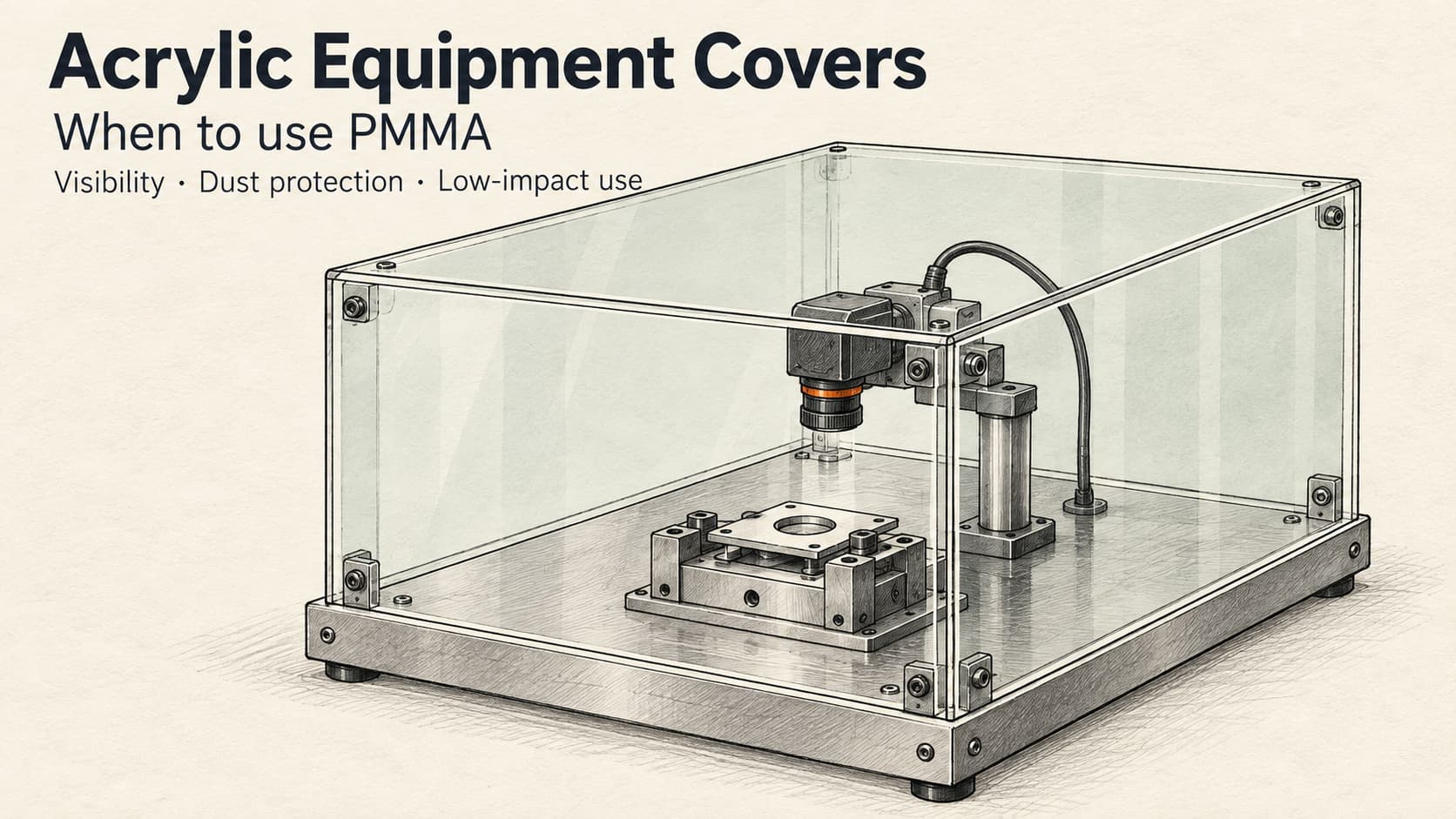
Acrylic sheets are useful candidates for clear, low-impact equipment covers. Start with the panel’s function, then choose the sheet, thickness, and fabrication method.
PMMA—the plastic commonly called acrylic—can suit observation, dust protection, and rigid fabricated shapes. Containing broken tools or flying workpieces requires selection based on the hazard and the complete guard design.
Can Acrylic Be Used for Machine Guards?
Yes, for suitable applications, but the word guard covers several different jobs. A transparent hood that keeps dust off an instrument and a window that must resist an ejected workpiece need different performance specifications.
Start by identifying the panel’s job:
- Observation — Provide a clear view of a process or component.
- Dust or limited splash — Exclude dust or intercept a compatible liquid.
- Access prevention or containment — Prevent access to moving parts or contain material thrown from the machine.
The first two functions create opportunities for PMMA. The third requires assessment of the guarding system, including the panel, frame, fixings, openings, and any access controls. For example, U.S. OSHA requirements address hazards such as rotating parts and flying chips, as well as how guards are secured and prevent access to danger zones.[1]
An observation window can still be part of a protective guard. Its viewing function does not remove any impact or access-prevention requirement.
Acrylic vs Polycarbonate for Machine Guards
Acrylic and polycarbonate are both available as clear sheet. Stiffness and impact toughness describe different behavior.
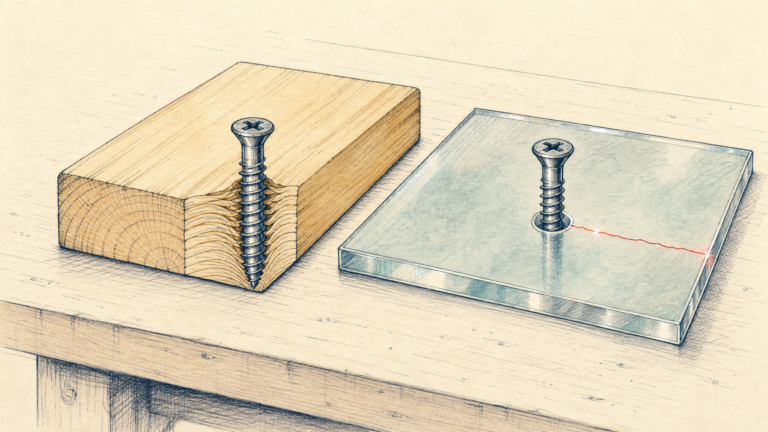
Conceptual loading sketches; not to scale. These show different demands, not material test results.
General-purpose acrylic is more rigid than polycarbonate, while polycarbonate is substantially tougher under impact. A panel that feels firm when pressed by hand therefore does not automatically provide better protection against a flying fragment.[2][3]
| Requirement | Acrylic / PMMA | Polycarbonate / PC |
|---|---|---|
| Clear observation | A suitable candidate for low-impact viewing panels | Clear grades also provide visibility |
| Resistance to bending | Generally more rigid in comparable ordinary sheet grades | Generally more flexible |
| Sudden impact or fragment containment | Greater brittleness limits its use | A stronger material candidate, subject to the complete guard specification |
On a narrow screen, scroll sideways to compare both materials.
This comparison helps narrow the material family. It does not specify a safe guard thickness or approve a finished assembly. Coatings, modified grades, temperature, and fabrication details also affect the result.
The distinction explains why one machine might use different transparent materials in different places. A removable instrument cover and a window facing a cutting operation do not necessarily benefit from the same sheet.
For a broader explanation of the material families, see our PMMA vs PC vs PS sheet comparison.
Where Acrylic Equipment Covers Make Sense
PMMA becomes a practical option when visibility and a custom cover shape matter more than impact containment. Consider these three application examples:
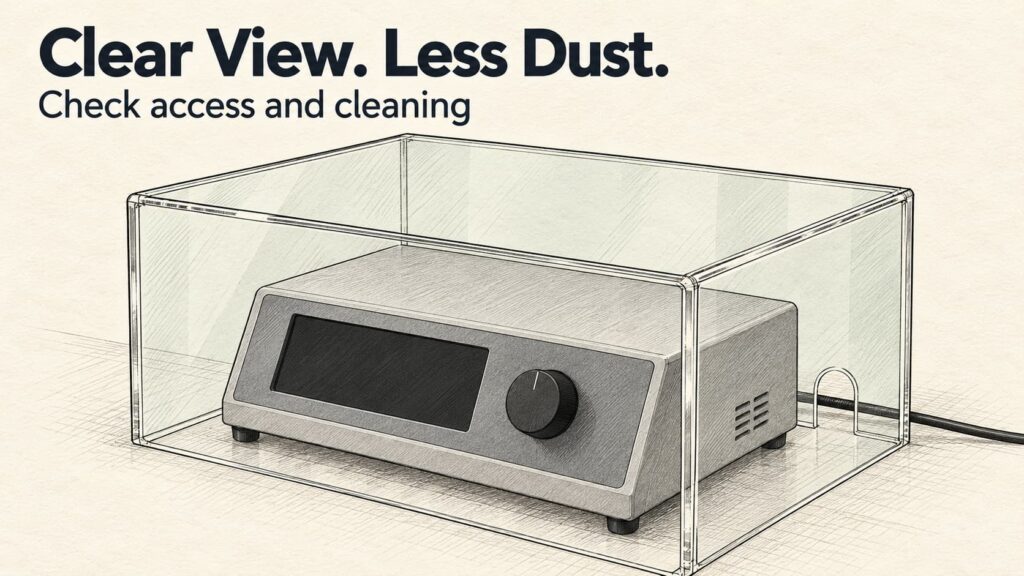
Instrument dust covers
A transparent hood over a benchtop instrument lets someone read an indicator while keeping settling dust away. Relevant details include access for adjustments, cable openings, lifting clearance, and the cleaning method. A simple hood does not automatically provide a sealed or rated enclosure.
External viewing panels
A clear panel can make labels, components, or a process visible through an equipment housing. The surrounding design must establish what hazards, if any, reach that opening. Visibility is useful only when the panel also meets the opening’s other requirements.
Covers for limited splashing
Where impact containment is unnecessary, a clear cover may intercept a compatible liquid while preserving a view. Here, the liquid’s composition, temperature, and contact duration become central to selection. “Splash protection” alone says too little about material compatibility.
These examples connect the application to a specification. Simply calling a part a packaging-machine cover, laboratory enclosure, or inspection window does not establish its suitability.
How to Choose Acrylic Sheet Thickness
Acrylic cover thickness should be selected alongside panel size, unsupported span, and mounting arrangement. A small panel supported around its perimeter behaves differently from a broad horizontal cover held at a few points.
Increasing thickness improves resistance to bending, but support and geometry also influence deflection. Under a sustained load, an inadequately supported thermoplastic panel can gradually change shape. This matters for horizontal covers carrying their own weight as well as panels expected to support an additional load.
For a low-impact cover, first establish the clear opening, support positions, orientation, and expected loads. Then assess the thickness and shape together. Where the panel performs a safety function, the relevant guarding requirements must also determine its specification.
Three dimensional requirements need separate attention. Thickness tolerance, part tolerance, and assembly clearance answer different questions.
Scroll the drawing sideways on a narrow screen to keep its labels readable.
- Sheet thickness tolerance: how much the supplied board’s thickness can vary. This affects its fit inside a frame, channel, or slot.
- Fabricated-part tolerance: the permitted variation in the cut outline, hole locations, and machined features.
- Assembly clearance: the space deliberately allowed for fitting and movement in the completed assembly.
A precisely cut outline does not correct an unsuitable board thickness. Equally, a panel that matches its drawing can still fit poorly if the drawing leaves insufficient assembly clearance. Keeping these requirements separate makes both fabrication and inspection clearer.
Cast or Extruded Acrylic for Cover Panels?
Both cast and extruded acrylic deserve consideration. The production route affects machining behavior, thickness consistency, and cost, so “cast” alone is not a complete specification.
Cast acrylic is often a useful starting point for machined components. Extruded acrylic commonly offers tighter thickness control, which can matter when a flat panel fits into a channel. These are practical differences to check against the chosen grade, rather than a rule that one production method is always better.[4]
For an equipment cover, connect those differences to the actual part: Does it need a controlled-depth recess? Must it fit an existing frame? Will it be bent or bonded? The answers give the grade decision a practical purpose.
Our cast vs extruded acrylic guide explains the wider fabrication trade-offs. Clear acrylic sheets are the relevant material starting point for covers that need an unobstructed view.
Fabrication and Mounting Affect the Finished Cover
The same acrylic sheet can produce different results depending on how it is cut, drilled, formed, and installed. A useful cover drawing therefore describes the features and interfaces that matter in service.
Cutting, Machining, and Edge Preparation
A flat, through-cut profile and a panel with recessed features require different process decisions. CO₂ laser cutting is one route for acrylic outlines; CNC routing or milling provides controlled-depth features such as pockets, steps, and counterbores.
Match the edge to its job. An exposed edge may need a clear finish, a fitting edge needs the correct geometry, and a bonding edge needs preparation suited to the joint. A glossy appearance alone cannot establish those other qualities.
Thermal cutting also introduces local stress, which matters during later processing.
Our CNC vs laser cutting acrylic guide explains how geometry and the required finished edge affect that choice.
Holes, Fixings, and Formed Shapes
Drilled holes and fasteners deserve particular care because loads act locally around them. Acrylic also changes dimensions with temperature, so the mounting arrangement must accommodate movement rather than force the panel against tightly positioned fixings.[5]
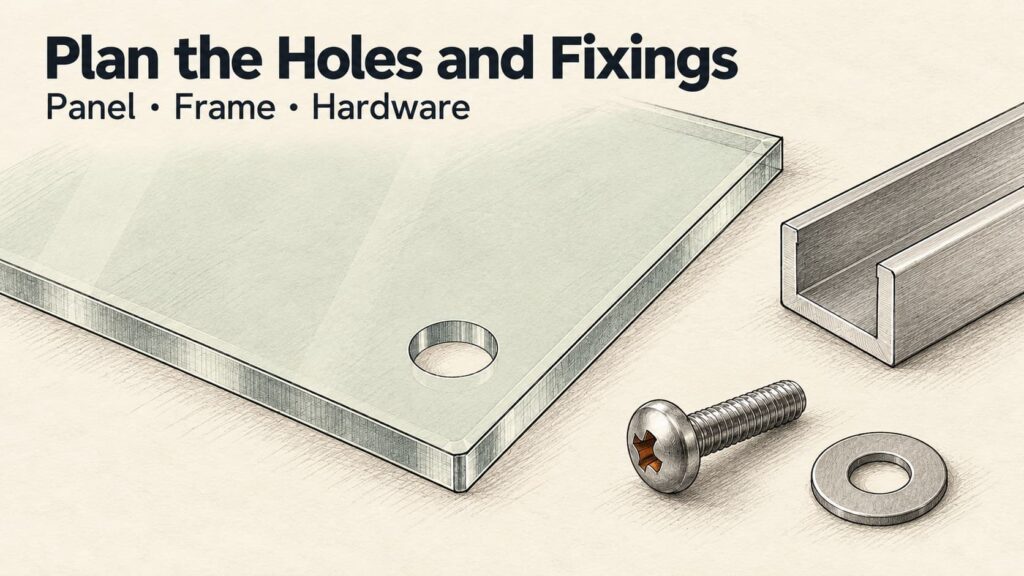
The practical aim is a panel that sits correctly in its intended mounting. Hole positions, edge distances, hardware, and tightening must work together.
Making the sheet thicker does not resolve every stress concentration around a fixing.
For a bent cover, assess the cooled, finished shape. A flat blank’s dimensions alone do not show whether the formed cover clears adjacent components or aligns with its mounting points. On the drawing, distinguish dimensions needed for the completed part from dimensions used only to make the blank.
Cleaning and Heat Belong in the Material Decision
Acrylic’s appearance in service depends on what touches it. Incompatible cleaners, cutting fluids, or bonding products can damage the material or trigger fine surface cracks known as crazing. The combination of chemical exposure and stress in a fabricated panel is particularly relevant.
The maintenance routine is part of material selection. A chemical name or product label is more useful than “cleaned regularly.”
- Chemical or product name and its concentration.
- Contact time and temperature during cleaning or process exposure.
- Stress in the finished panel, including processed and mounted areas.
A sample evaluated with water alone does not establish compatibility with a different cleaning fluid.
Heat needs the same attention. Identify the temperature at the cover during operation, including nearby heat sources. A softening temperature from a data table is not a continuous-use rating, and a material’s ability to retain its shape depends on the load as well as temperature.[5]
For example, a cover beside a heated process may experience a different environment from the surrounding room. Evaluating room temperature alone would miss the condition that actually affects the panel.
Confirm the Finished Cover Before Repeat Production
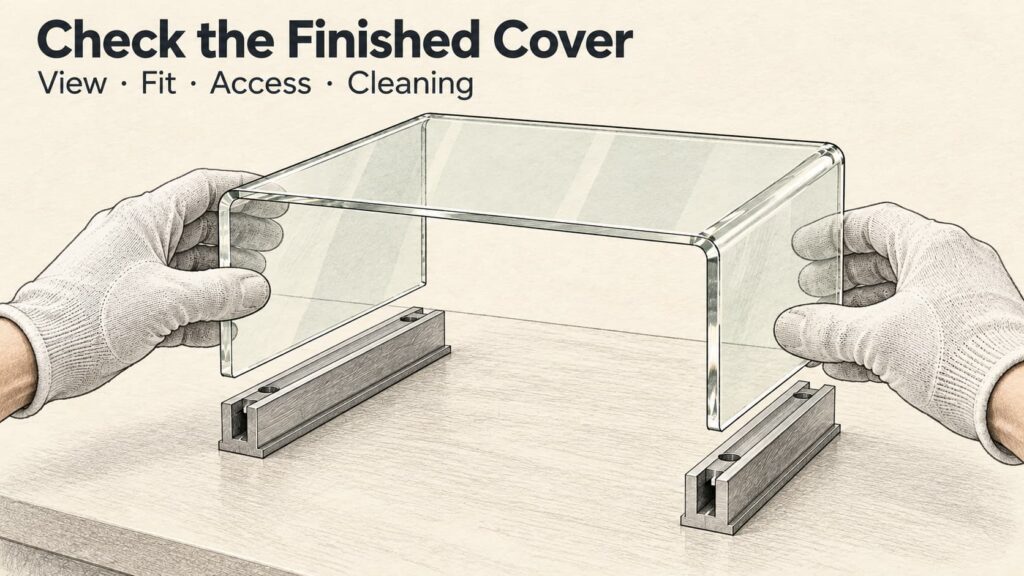
Once PMMA suits the application, evaluate a representative finished panel in its intended assembly. A clear offcut shows the material’s appearance; it cannot show the fit of drilled holes, the alignment of bends, or access for maintenance.
A fit check does not establish containment performance. Where protective performance is required, it needs its own appropriate validation.
Also define the supply format so that quotations cover the same scope of work:
- Whole sheets — For buyers doing their own fabrication.
- Cut blanks — Agreed finishing operations remain with the buyer.
- Fabricated panels — Include the features specified on the approved drawing.
PMMA offers a useful combination of visibility and fabrication options for suitable equipment covers. Its value comes from matching the sheet to the cover’s function, environment, and finished geometry.
Planning an acrylic equipment cover?
For a starting discussion about sheet supply and fabrication, send Grandview your drawing and required quantity, together with a brief description of what the panel needs to do.
References
[1]OSHA — 29 CFR 1910.212 — General requirements for all machines
U.S. requirements covering machine hazards, guard security, and access to danger zones. View source: OSHA, 29 CFR 1910.212 — General requirements for all machines
[2]ACRYLITE — Cell Cast Sheet Physical Properties — Technical Information
Physical behavior and design considerations for the manufacturer’s specified acrylic sheet. View source: ACRYLITE, Cell Cast Sheet Physical Properties — Technical Information
[3]Palram — PALSUN Technical Guide
Polycarbonate material and fabrication guidance; document hosted by Perspex. View source: Palram, PALSUN Technical Guide
[4]ACRYLITE — Comparing Cast and Extruded Acrylic Sheet
Machining and thickness-control differences within the manufacturer’s product range. View source: ACRYLITE, Comparing Cast and Extruded Acrylic Sheet
[5]PERSPEX — Design Guide
Machining, laser-cut edges, fixings, thermal behavior, and chemical exposure. View source: PERSPEX, Design Guide
Related Reading
- Acrylic Heat Resistance: Service Limits and Thermal Expansion — Understand how service conditions differ from softening and forming temperatures.
- Thermoforming Acrylic Sheets — Explore how forming affects the shape and quality of acrylic components.