Acrylic sheet pricing · Material and cost logic
Acrylic sheet cost per square foot is usually quoted by area, per square foot, per square meter, or per full sheet. What you are mostly paying for, though, is material, and the amount of material in one square foot changes with thickness.
Thickness explains most of the gap between two sheets. The rest comes from three things: how the sheet was made, whether it carries added color, finish, or coatings, and what the price includes beyond the sheet itself, such as cutting, unused offcuts, packaging, and order size.
That is also why published “price per square foot” figures are so hard to compare. A figure for a small retail-cut piece, one for a full sheet bought from a distributor, and one for a pallet quoted at a factory are measuring different things, even when the units match.
Square feet is how acrylic is quoted. Weight is a large part of what you are paying for.
- MaterialThickness sets how much PMMA is in each square foot
- Sheet typeCast or extruded; color, finish, functional grade
- Usable shareHow much of the sheet ends up in parts
- What is includedCutting, packing, quantity, delivery point
This guide explains each factor: what it changes and why it moves the number.
Thickness: Priced by Area, Paid for by Weight
A square foot of 1/4″ (6 mm) acrylic contains about twice as much PMMA as a square foot of 1/8″ (3 mm) acrylic. That is the clearest single reason prices climb with thickness.
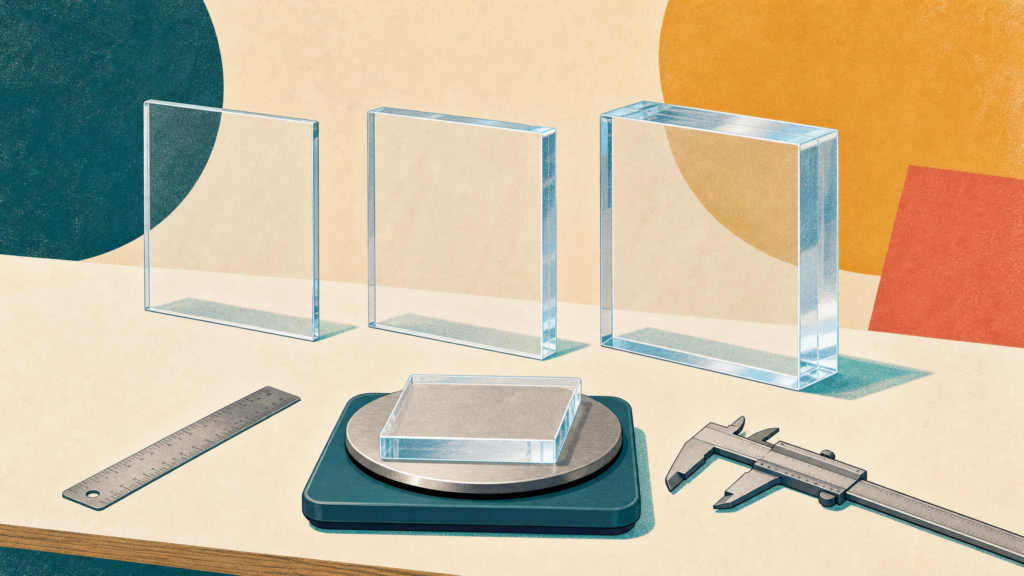
Acrylic’s density is about 1.2 g/cm³,[1] so the weight per square foot can be worked out from nominal thickness alone.
| Nominal thickness | Material per sq ft | Approx. per m² | Approx. 4 × 8 ft sheet |
|---|---|---|---|
| 2 mm | 0.49 lb | 2.4 kg | 7.1 kg (15.7 lb) |
| 3 mm (≈1/8″) | 0.74 lb | 3.6 kg | 10.7 kg (23.6 lb) |
| 5 mm | 1.23 lb | 6.0 kg | 17.8 kg (39.3 lb) |
| 6 mm (≈1/4″) | 1.47 lb | 7.2 kg | 21.4 kg (47.2 lb) |
| 10 mm | 2.46 lb | 12.0 kg | 35.7 kg (78.7 lb) |
Calculated from 1.2 g/cm³ and nominal thickness; a 4 × 8 ft sheet is about 2.97 m². Actual weight follows the measured thickness and the specific product. Scroll the table sideways on a small screen.
The table explains why a price per square foot is not meaningful unless the thickness is stated. Two figures for “clear acrylic” can describe sheets with very different amounts of material behind them.
The relationship is not perfectly proportional, however. Very thin and very thick sheets can each carry their own production and handling costs, and a heavier sheet costs more to pack and ship. As a starting point, though, doubling the thickness roughly doubles the material behind every square foot.
Nominal Thickness Is Not Always Measured Thickness
A sheet sold as 3 mm is a nominal 3 mm. Each product has a permitted thickness range, and that range can be wider than buyers expect. One manufacturer’s datasheet for cell cast acrylic allows ±(0.4 mm + 10% of nominal thickness).[1] For a 3 mm sheet, that is ±0.7 mm.
Under that tolerance, two sheets can both be “3 mm” and still differ noticeably in material per square foot. Other products are made to tighter ranges, so the figure above describes one specification, not acrylic in general.
The practical point stands: when two 3 mm sheets carry different prices, part of the gap may be that they are not quite the same thickness. If thickness matters for fit or appearance, it is worth asking for the tolerance as well as the nominal size. The acrylic sheet thickness guide covers how to choose thickness in the first place.
Cast or Extruded: Two Production Routes, Two Cost Structures
Clear acrylic sheet is generally made in one of two ways. Cast sheet is polymerized in batches, sheet by sheet, between molds. Extruded sheet is produced continuously by pushing molten material through a die. The cast and extruded production process is explained in detail elsewhere.
Each sheet forms in its own casting cell. That takes more time per sheet, but it is flexible for small color runs and a wide thickness range.
A continuous line spreads setup over long runs, which generally makes it the lower-cost route for standard clear sheet in common thicknesses.
The same production difference shows up in what each route does well. The two types also behave differently in laser cutting, engraving, and machining. A lower price per square foot is a real saving only if the sheet suits the way the part will be made and seen. The cast vs extruded acrylic sheets comparison explains those trade-offs.
Color, Finish, and Functional Grades: Added Steps Add Cost
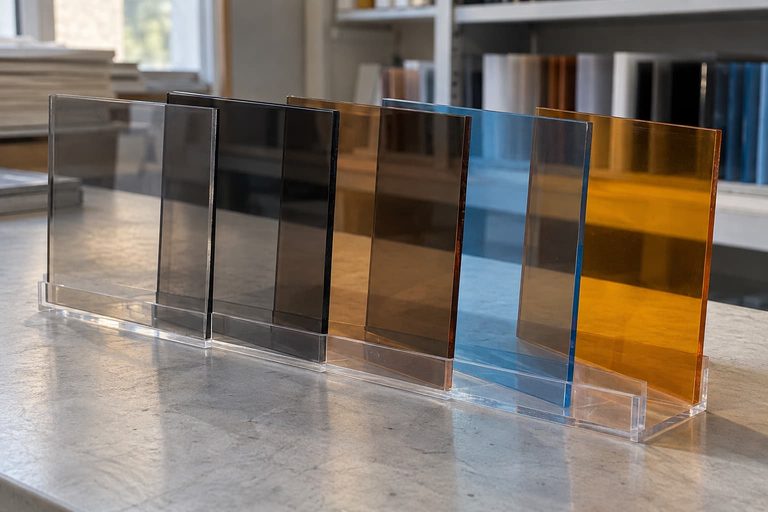
Clear sheet is the base product for most producers. Most other variations add something to it: an ingredient, a process step, or a smaller production run.
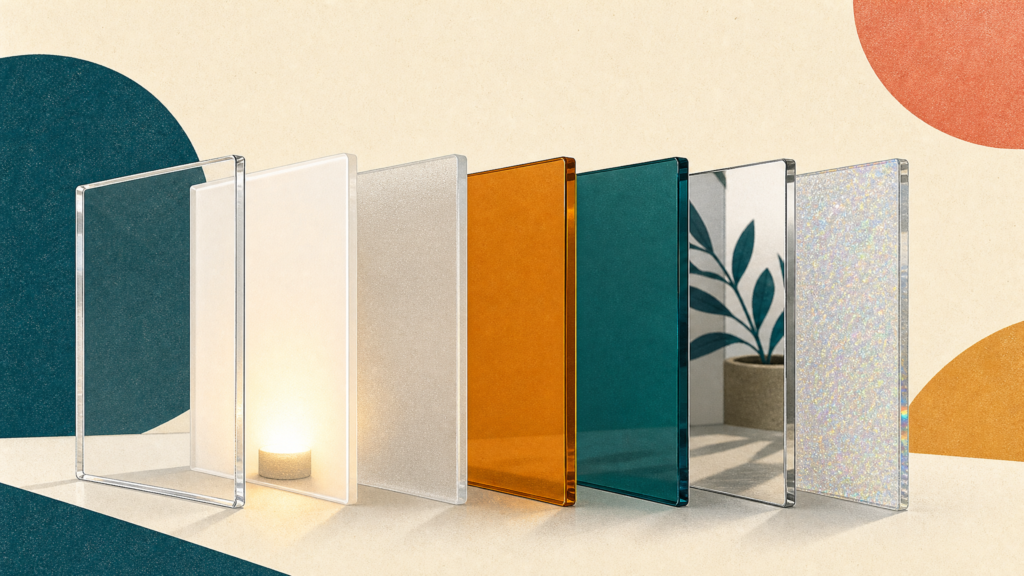
| What changes | Source of the added cost |
|---|---|
| Standard colors (white, black, common tints) | Pigment, plus production time spent switching colors |
| Custom color matching | Matching and approval work, and a dedicated run that may be smaller than usual |
| Opal and diffuser grades for lighting | Formulations designed to spread light evenly, not just to look white |
| Frosted or matte surfaces | A textured mold surface or added surface treatment |
| Mirror sheet | A reflective metallized layer and protective backing applied to the sheet |
| Glitter, iridescent and other decorative sheets | Special inclusions or effects, often made in smaller batches |
| UV-stabilized and coated grades | Additives or coatings for outdoor use, abrasion, or other functions |
These differences explain why a premium on one type of sheet is not arbitrary. Where suppliers draw the price lines varies, though. Common colors that sell in volume may be priced close to clear, while a specially matched color behaves more like a small custom run.
Pay for a property only where the part uses it. A UV-resistant grade earns its cost on a sign that faces the sun, not on an indoor display. A true diffuser matters inside a lightbox; a cosmetic stand may look just as good on standard white.
The types of acrylic sheets overview shows how these categories overlap, and the guide to acrylic sheet finishes explains what each surface actually does.
Sheet Size and Yield: The Square Feet You Use vs the Square Feet You Buy
A full sheet’s price per square foot only describes the full sheet. Once parts are cut from it, the cost that matters is the cost of the material that ends up in usable parts.
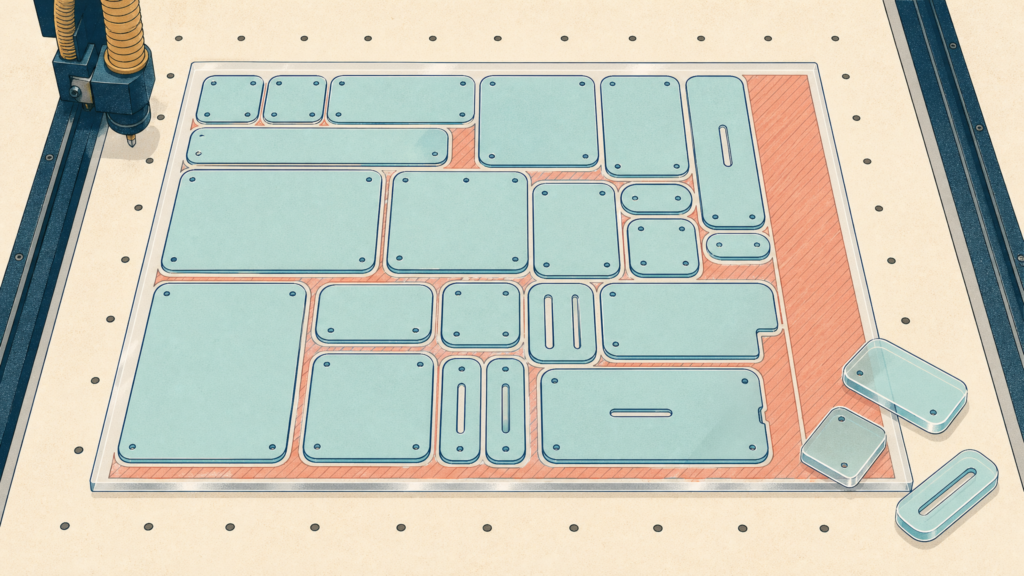
The arithmetic shows why the part layout can matter as much as the sheet price. A part that nests efficiently on a 4 × 8 ft sheet may waste a strip on a metric sheet of a slightly different size, or the reverse. The acrylic sheet sizes guide works through this layout question.
Sheet size affects price in a second way. Larger formats can reduce seams and improve layouts for long parts. They also need bigger machinery, careful handling, and more substantial packaging, and not every color or thickness is made in every size.
What the Price Includes, and Where It Is Measured
The same sheet can carry very different prices per square foot depending on how it is bought.
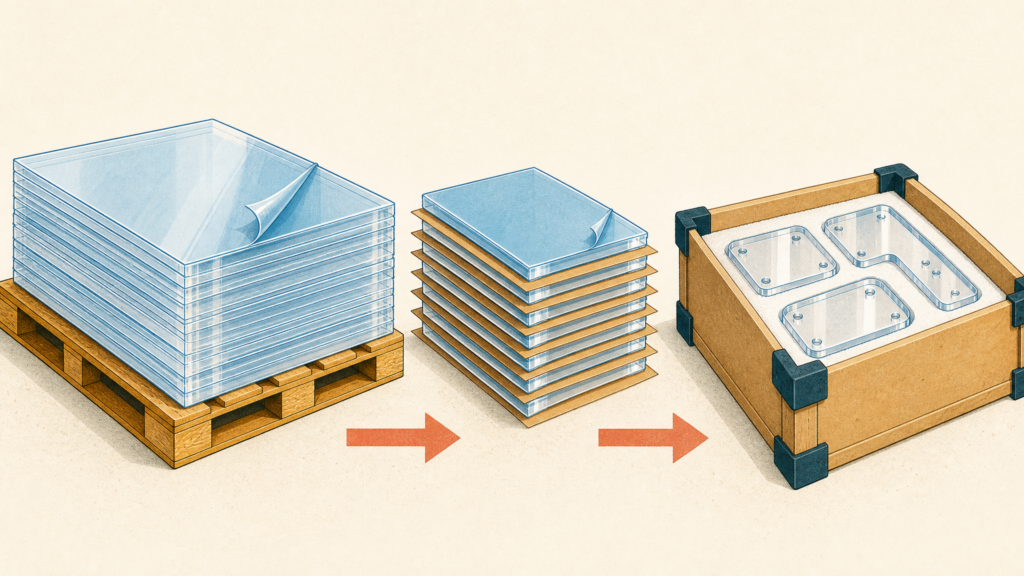
A full sheet, a rectangular cut-to-size blank, and a finished part with holes, polished edges, or printing are three different purchases. A cut-to-size price includes the cutting, the handling of each piece, and usually some unused material. A finished-part price also includes the fabrication route; for example, laser cutting and CNC machining can lead to different finishing work on the same outline. Dividing a part price by its area and comparing the result with a sheet price per square foot mixes these stages together.
Small orders carry handling, cutting, and packing effort that does not shrink with area. That is why a small piece bought individually usually costs far more per square foot than the same material bought as full sheets. At the other end, larger orders spread setup and packing work across more material and can ship more efficiently.
Acrylic scratches easily, so it is shipped with protective film and, depending on the order, interleaving, edge protection, pallets, or crates. Heavier, thicker, and oversized sheets cost more to move. Whether a price is measured at the factory, at a port, or at the buyer’s door changes what it covers.
Acrylic is made from methyl methacrylate (MMA) monomer. When the cost of that raw material, energy, or freight moves, sheet prices follow. A price figure is a snapshot of one specification, at one time, in one market.
Reading Two Price Figures Side by Side
Before comparing two prices per square foot, check that they describe the same thing.
- Same thickness, and ideally the same tolerance. Otherwise the material content differs.
- Same type and grade. Cast or extruded; clear, colored, or functional.
- Same delivery stage. Full sheet, cut blank, or finished part.
- Same quantity basis. Single piece, full sheets, or a pallet or container.
- Same delivery point. Factory, port, or delivered.
If those points match, the comparison is meaningful. If they don’t, converting both figures to cost per kilogram at the stated thickness is often the fairest way to compare raw sheet. For cut or fabricated material, the better comparison is cost per usable part.
FAQ
How do I convert a price per square meter to a price per square foot?
One square meter is about 10.76 square feet, so divide the per-square-meter price by 10.76. A 4 × 8 ft sheet is 32 square feet, or about 2.97 square meters.
Is a lower price per square foot a sign of thinner sheet?
Not necessarily. It may reflect a different grade, production route, quantity, or delivery point. Thickness is still worth checking first, because it is the factor that most directly changes how much material is in each square foot.
Why does mirror acrylic cost more than clear acrylic of the same thickness?
Mirror acrylic starts as a sheet and then receives a reflective coating and a protective backing. You are paying for those extra steps on top of the base sheet. The acrylic mirror vs glass mirror comparison explains how that construction behaves in use.
The Short Version
Acrylic sheet cost per square foot is mainly a question of how much material is in each square foot, what kind of sheet it is, and what else the price includes. Thickness sets the baseline. Production route, color, finish, and functional grade move it up or down. Yield, quantity, packaging, and the point where the price is measured decide what you actually pay per usable piece.
If you are working out the material for a specific project, Grandview Acrylic can review the clear or colored acrylic sheets you are considering. Share the thickness, finished part sizes, and quantity, and we can tell you whether full sheets or cut-to-size panels make better use of the material.
References
[1] PLASKOLITE — OPTIX R Cell Cast (Recycled) Sheet, Product Data Sheet (PDF)
Density per ISO 1183 and the thickness tolerance for 3–20 mm sheet of this specific cast product; used here for the weight calculation and the tolerance example. View source.